
Updated September 2026. I’ve rewritten this post to answer one question properly: should you go custom, and what’s actually possible? I’ve corrected a few things I got wrong first time round (the US power supply, draining the tub and blowers), and added what custom really costs and the ways I can help. If you’ve already decided to go custom and want to know how the design process works, read Custom designed hot tub: the process explained.
From personal experience, there’s nothing better than getting into a hot tub you designed and built yourself. The best compliment you can get is a friend asking, “Did that come as a kit?” That’s when you know you’ve done a good job.
So can you build your own custom hot tub? Yes, you can. I did, and I’ve since helped more than 1,500 people build theirs. But starting a custom build without a plan is like turning up to a gunfight without a gun. You simply don’t want to do it. This post covers whether custom is right for you, what’s possible, and the decisions you need to make before anyone draws a line.
The short version
- Go custom when a shop-bought tub won’t fit, won’t get there, or won’t do what you want: an odd-shaped space, no crane access, an infinity edge, a water feature, a pool or cold plunge alongside.
- Almost anything is possible, but square and rectangular tubs are far easier to build than curves. Be honest about your own skills.
- Decide the big things first: location, power, water in and out, indoor or outdoor, construction method, jets and pumps, heating and the control room.
- Power: a proper jetted tub needs its own dedicated circuit, typically 32A or 40A in the UK and 240V (usually 50A or 60A) in the USA, installed by a qualified electrician.
- Water features get their own pump. Every time.
- You don’t have to design it alone. Start with standard plans, the free Tub & Pool Designer Pro software, or a full custom design consultancy.
Why build a custom hot tub?
There are plenty of reasons to go custom. Some are practical, and some are pure vanity (big smiley face). For me it was practical. I wanted a hot tub, but there was no way of getting one delivered to where I wanted it. My garden is long with a tight turn, so it couldn’t be craned in, and a shell certainly wouldn’t go round the corner. I had to build my own. Lucky I did, because it turned into this business.
The common reasons I hear from customers are:
- Access. Like me, you can’t get a shell or a crane to the spot you want.
- Space. An awkward corner, a slope, a basement or a gap between two walls. A custom tub fits the space rather than the other way round.
- Features. Infinity or spillover edges, waterfalls, loungers, swim jets, a cold plunge or a pool alongside.
- Spec. You choose the jets, the pumps, the heating and the finish, and you use standard parts you can repair or replace for years to come.
- It looks built-in, because it is. It’s part of the garden, not a plastic box sat on a patio.
It’s not automatically cheaper than buying, though. I’ve been honest about that in Pros and cons of building a hot tub.
Custom, standard plans or shop-bought: which suits you?
“Custom” doesn’t have to mean starting from a blank sheet. Here’s how the options compare:
| Route | Best for | Watch out for |
|---|---|---|
| Shop-bought hard shell | Soaking within weeks, one warranty, no building | Access for delivery, fixed size and layout, proprietary parts |
| Standard DIY plans | A square or rectangular in-ground tub in a proven size | The size has to suit your space |
| Free designer software plus CAD | Your own size or layout, drawn up properly for a builder or permit | You design the shape yourself first |
| Full custom design consultancy | Unusual shapes, water features, infinity edges, pool combos, tricky sites | Costs more, and you need to know roughly what you want |
Most people who build with me use the standard plans. The most common DIY size is 8ft x 8ft, and if that fits your garden there’s no need to reinvent it. Go custom when the standard sizes genuinely don’t work for you.
What’s possible with a custom hot tub?
Honestly? Almost anything. Everything is possible. We just have to plan and design for it. Here’s what I see people build most:
- Odd shapes and sizes. L-shapes, long narrow tubs, octagons and round tubs.
- Infinity and overflow edges. The main difference is the plumbing. The overflowing water is collected in a balance tank, and the jets draw from the tank rather than the tub. See How to build a DIY infinity or overflow hot tub.
- Water features. Waterfalls, water blades and cascades. See Adding a water feature to your DIY hot tub.
- Loungers and deep seats, laid out around how you actually sit.
- Hot tub and pool combos, with a spillover or kept separate. See my hot tub pool combo design guide.
- Hot tub and cold plunge together.
- Indoor and basement tubs. See Can you build a hot tub in a basement?
For real examples, have a look at Francisco’s fire pit hot tub and Marc’s build in an awkward space.
What you need to decide before going custom
Location: water in and water out
If you’re lucky enough to have more than one possible spot, think about the practical stuff first. How will you fill the tub? Is there an outside tap nearby, or will a garden hose do?
And where will the water go when you empty it? You won’t empty it often, so a long hose to a suitable drain is fine. That’s what I do. A correction here: when I first wrote this, I said to run the hose “into the main drain”. To be clearer, that should be a foul drain (the one your sinks and toilets use), not a surface water or storm drain, which goes straight to rivers and streams. In the USA, the EPA’s guidance is to drain to the sanitary sewer, or dechlorinate the water first if you’re going to use it any other way. Your local rules come first.
Power
Your hot tub needs power, and quite a lot of it. When I first wrote this, I said you’d need 40A at 230–240V “even in the USA”, using the “split system” in your home. Let me tidy that up:
- UK: A full-size tub usually needs a dedicated 32A or 40A circuit with a 30mA Type A RCD (an RCBO is neatest) and a local isolator within sight of the tub, at least 2m from it. It’s notifiable work under Part P.
- USA: Homes have a 240V split-phase supply, and most residential hot tubs run on a 50A or 60A dedicated 240V circuit with GFCI protection and a disconnect in line of sight, no closer than 5ft to the water. 120V plug-in tubs exist, but they don’t have the power for a proper jetted, heated build.
The exact size depends on your heater and pumps, and your electrician does the calculation. It’s not something I’d recommend doing yourself, even if you’re a competent DIYer. There’s more in Hot tub wiring explained.
Indoor or outdoor?
Most of the custom tubs I design are outside. That brings its own challenge: insulation. Without it, as I found out myself, running costs get high on electric heating.
Indoor tubs aren’t a huge problem, but you must think about ventilation. Hot, moist air with nowhere to go will cause damp and mould over time. Specialists in pool rooms aim for 50–60% relative humidity, which usually means proper dehumidification, not just an open window. This matters even more in basements, which are getting more and more popular.
Layout, and your own skills
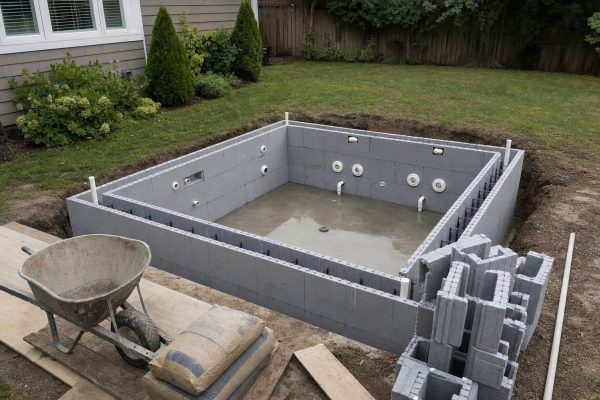
Square and rectangular tubs in block or ICF are much easier to build than kidney shapes and curves. Think about the materials, but also about what you can actually do if you’re building it yourself. I wouldn’t try curves in blockwork. My bricklaying just isn’t up to it, and I found four and a half courses of block for my own square tub hard enough! If you want curves, poured concrete or a builder who does curved work regularly is the way to go. See Hot tub wall construction: what are the options?
Water depth, and skimmer or infinity?
I generally use a water height of 90cm, measured to the centre of the skimmer. In the first version of this post I converted that to 39.5in, which was wrong. 90cm is about 35.5in. You can go deeper if you want, because it’s your custom tub. Seat heights and depths are covered in What makes a good DIY hot tub design?
A skimmer is the simple option. An infinity edge is more work, but totally doable, as long as it’s designed in from the start.
How many jets, and how many pumps?
The age-old question. You can have as many jets as you like, but more jets need more pumps. My rule of thumb is that one jet pump runs up to about 16 jets. The jets I use need around 10 GPM each, so 16 jets need about 160 GPM. A decent pump close to the tub, not pushing water up any real height, might produce about 200 GPM, which leaves you about 160 GPM at the jets once friction has had its share.
That’s a rule of thumb, not a calculation. The more pipe and fittings, the more flow you lose, so on a custom design we work it out properly. See How many pumps do you need?
Blower or venturi?
I’m still a big fan of a blower. It’s cheap, nearly every spa pack has a connection for one, and it’s what gives you that bubbly hot tub feeling. When I first wrote this I said you wouldn’t use venturi on a block or concrete tub. That was too strong. You can, and I’ve since shown how in How to use a venturi system instead of a blower on a block hot tub. For most builds I’d still fit a blower.
Heating
The main options are electric, gas or propane, and air source heat pumps:
- Electric (usually the spa pack’s heater) is the easiest to install but the slowest to heat.
- Gas or propane heats the fastest, but costs the most to run.
- An air source heat pump is the most economical. The US Department of Energy says pool heat pumps typically deliver 3 to 7 units of heat for every unit of electricity, though they work best above about 50°F (10°C). Adding one to my own tub cut my running costs by 66%. See How I reduced my hot tub running costs by 66%.
There’s a full comparison in What is the best method to heat my DIY hot tub?
Water features: always on their own pump
Adding a waterfall or cascade is totally possible and not too difficult. But I always design water features on their own plumbing, with their own pump and a lower drain. That gives you full control. The last thing you want is to be short of flow on your jets or your water feature because they’re fighting over one pump.
The control room
This is where the pumps, filter, spa pack and heater live, and it’s the bit I got wrong on my own build. Make it bigger than you think, keep it close to the tub, and decide whether it sits above or below the water line early on, because that affects which pumps you can use. See Hot tub control room position.
What does a custom hot tub cost?
It varies hugely with size, finish and features. For context, HomeGuide puts a professionally built custom in-ground hot tub at around $8,000–25,000 in the USA. Building it yourself saves most of the labour, but the materials and equipment still add up, and every feature (a second pump, a water feature, a heat pump) adds cost. The design is the cheapest place to make changes, and mistakes discovered after the concrete goes in are the most expensive.
Common mistakes on custom builds
- Designing the shape and forgetting the plumbing. The plumbing layout is the key to a custom tub working the way you want.
- Adding features halfway through. A water feature or extra jets needs pipes, drains and a pump that have to be in before the concrete.
- A control room that’s too small or too far away.
- Curves beyond your skills.
- Going too big. More water means a bigger heater and higher running costs.
- Leaving the electrics until the end. Plan the cable route before you pour.
- Forgetting permits. In England a garden hot tub typically doesn’t need planning permission unless you’re in a listed building or conservation area, but the electrics must meet Building Regulations. In the USA, many areas want a permit. See Do I need a permit for my hot tub?
Planning your own custom build?
Getting the design right from the start is key. For me, the most important part is the plumbing layout and working out exactly how you want the tub to function. There are a few ways I can help, depending on how custom you’re going:
- A standard size fits? My DIY hot tub plans ($149) give you CAD drawings, plumbing diagrams, a parts and materials list, the build guide and the video course, with email support if you get stuck.
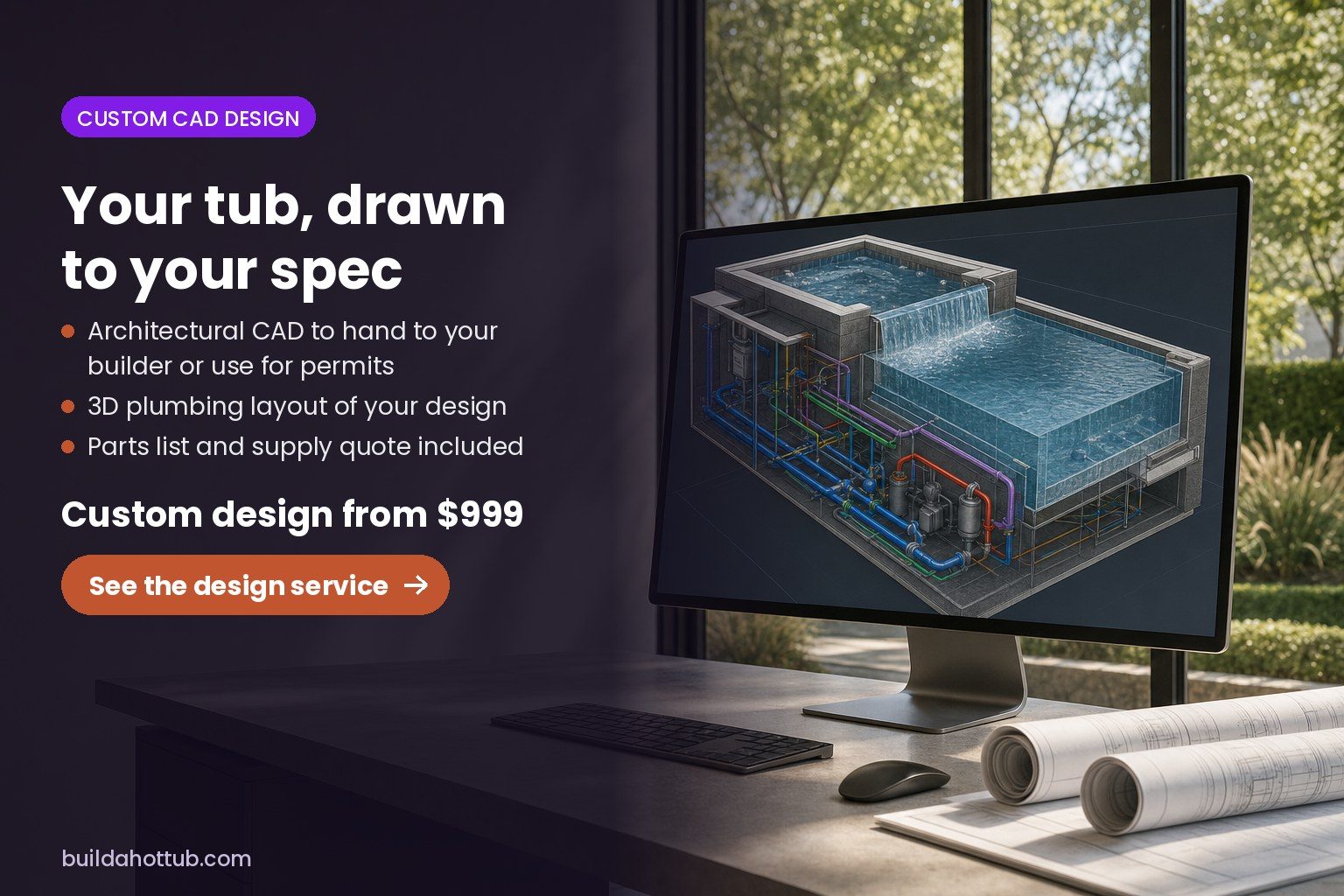
- Want to design your own layout? Try the free Tub & Pool Designer Pro software. It lets you build a 3D design with real measurements and drag in jets, benches and features. Then I can turn your design into architectural CAD and a 3D plumbing design ($999), with the CAD in PDF and DWG for your builder or permit, the build documentation and a parts quotation.
- Something truly custom? My custom hot tub (or pool) design consultancy ($2,497) takes you from your rough sketch to a 3D model, 3D plumbing layout, architectural CAD, build documentation and a parts quotation. If there’s a pool involved too, there’s the custom hot tub and pool combo design consultancy ($2,997).
I’ve explained each step of the custom design process in Custom designed hot tub: the process explained.
FAQs
Can I build my own custom hot tub?
Yes. Block or ICF in-ground tubs are well within reach of a competent DIYer with good plans. Leave the electrics to a qualified electrician, and keep the shape within your skills.
Is a custom hot tub cheaper than buying one?
Not always. A DIY build usually compares well with a premium hard shell or a professionally built in-ground spa, but it costs more than a budget shell. You build custom for the size, shape, features and quality, not just to save money.
What is the best shape for a DIY hot tub?
Square or rectangular is the easiest to build, plumb and cover. Curves look great, but they’re much harder in blockwork.
How deep should a custom hot tub be?
I usually design for 90cm (about 35.5in) of water to the centre of the skimmer. You can go deeper, but your seats need to suit the depth so your shoulders stay under the water.
How many jets can a custom hot tub have?
As many as you like, as long as you have enough pumps. As a rule of thumb, one jet pump runs up to about 16 jets. More than that needs a second pump.
Can I add a waterfall to my hot tub?
Yes. Plan it at the design stage and give it its own pump and lower drain, rather than teeing it off the jets.
Thinking about a custom tub of your own? Tell me about it in the comments below. I read them all.
Cheers,
Andi
You can also find me on my socials;






looking for hot tub & pool parts?
I have everything you need....
If you are looking for Hot Tub & Swimming Pool Parts, either for your DIY Hot Tub, plunge pool or swim spa build, or you are looking for parts to repair your pool or hot tub - then check out my USA & UK stores below.
I carry 30K+ product lines across the stores

Can I Help You?
If I can help you in any way I would love to hear from you. You can get in touch using the form below.
Thanks - Andi
 Hi, Andi here. I own Buildahottub.com and also write all of the articles and info pages on the site. Some years back now, I built my own hot tub but struggled to find the information I needed. So, once my tub was complete, I started this website to help others in their own pursuit of hot tub and plunge pools DIY building information.
Fast forward to 2025, I've helped over 1400+ DIY customers just like you all over the world build hot tubs and pools. Have a good look around the site, there are lots of resources here. Please do get in touch if I can help you. - Cheers, Andi
DIY Hot Tub Cost Breakdown for 2026: Where the Money Actually Goes
What does a DIY hot tub cost in 2026? A line-by-line breakdown of an 8ft [...]
Sep
Can a Self-Confessed Rubbish DIYer Build a Hot Tub? Meet Matt
his might just be the biggest challenge my DIY hot tub plans have ever faced. [...]
Jun
What I’d Change If I Built My DIY Hot Tub Again
Around eight years ago, I built my own DIY hot tub. You've probably seen it [...]
May
Out With the Cedar, In With an ICF Inground Hot Tub
Right, I've got a brand new project to introduce to the channel today – and [...]
Apr
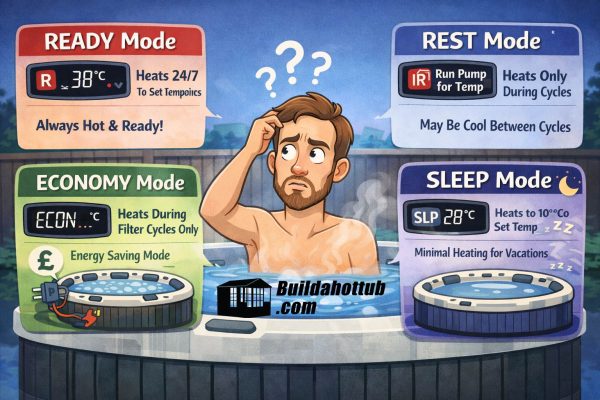
Balboa Heat Modes Explained: Ready, Rest, Economy and Sleep — What They Actually Mean
If you've got a Balboa-controlled hot tub and you're not sure what all those heating [...]
Mar
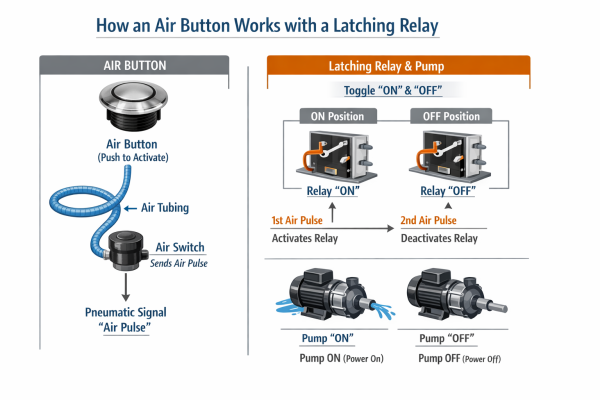
How to Change an Air Button and Latching Relay on a Hot Tub, Pool or Spa Bath
If you've got an air button that's stopped working, or a latching relay that's given [...]
Mar
How to Choose the Right Air Source Heat Pump for Your Hot Tub or Pool
With so many air source heat pumps on the market right now, choosing the right [...]
Mar
Hot Tub vs Plunge Pool – Which Should You Build in 2026?
Right, this is one of those questions that lands in my inbox on an almost [...]
Mar