
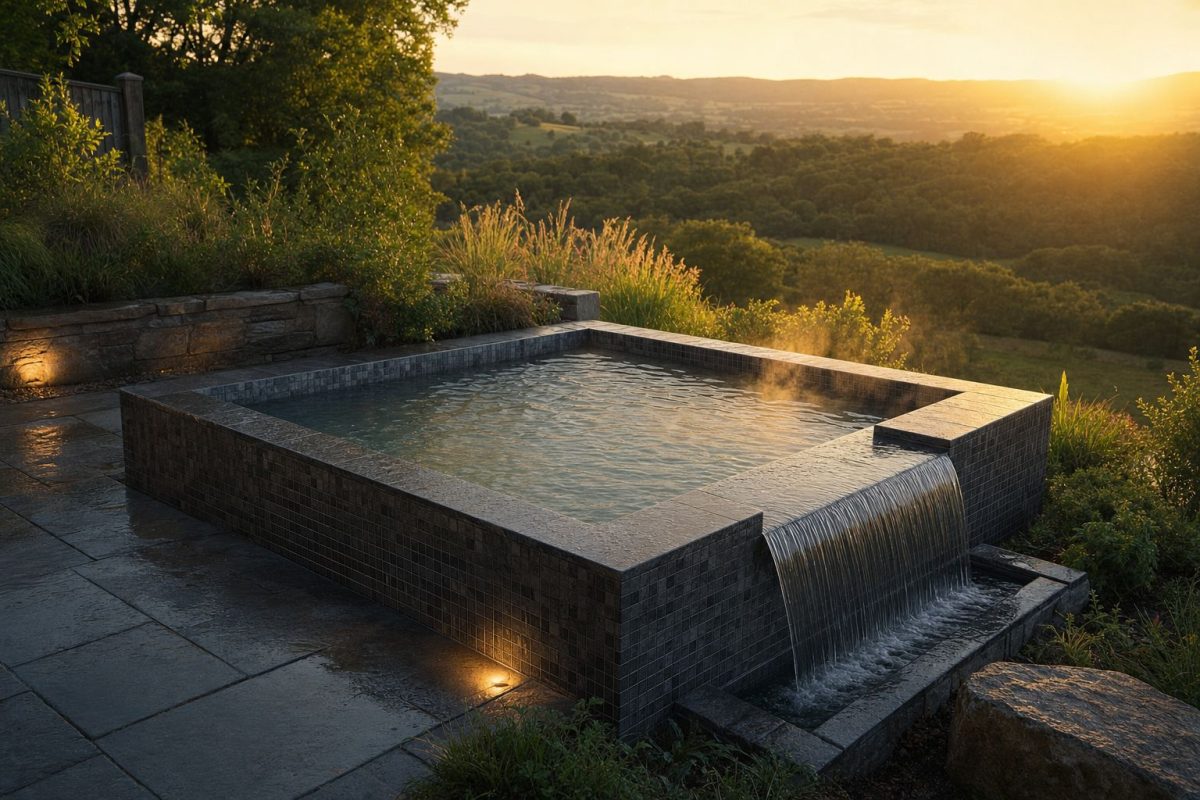
An infinity edge is the single most requested “wow” feature I get asked about, and the very next question is always about infinity hot tub cost: how much more does that overflow edge really add? The short answer is that the edge itself isn’t the expensive bit. It’s everything that has to sit behind it: a catch trough, a balance tank, a second pump, more pipework, a top-up system and more tiling. In this post I’ll break down where the extra money goes on a DIY build in 2026, what it adds to your running costs, and where you can (and can’t) save.
As in my DIY hot tub cost breakdown, I’m using an 8ft x 8ft (2.44m x 2.44m) in-ground tub as the example, with one overflow edge facing the view. All figures are rough 2026 ranges in US dollars and pounds sterling. They vary a lot by region, supplier and exchange rate, and the pound figures are typical UK prices rather than straight conversions, so treat them as a starting point for your own quotes.
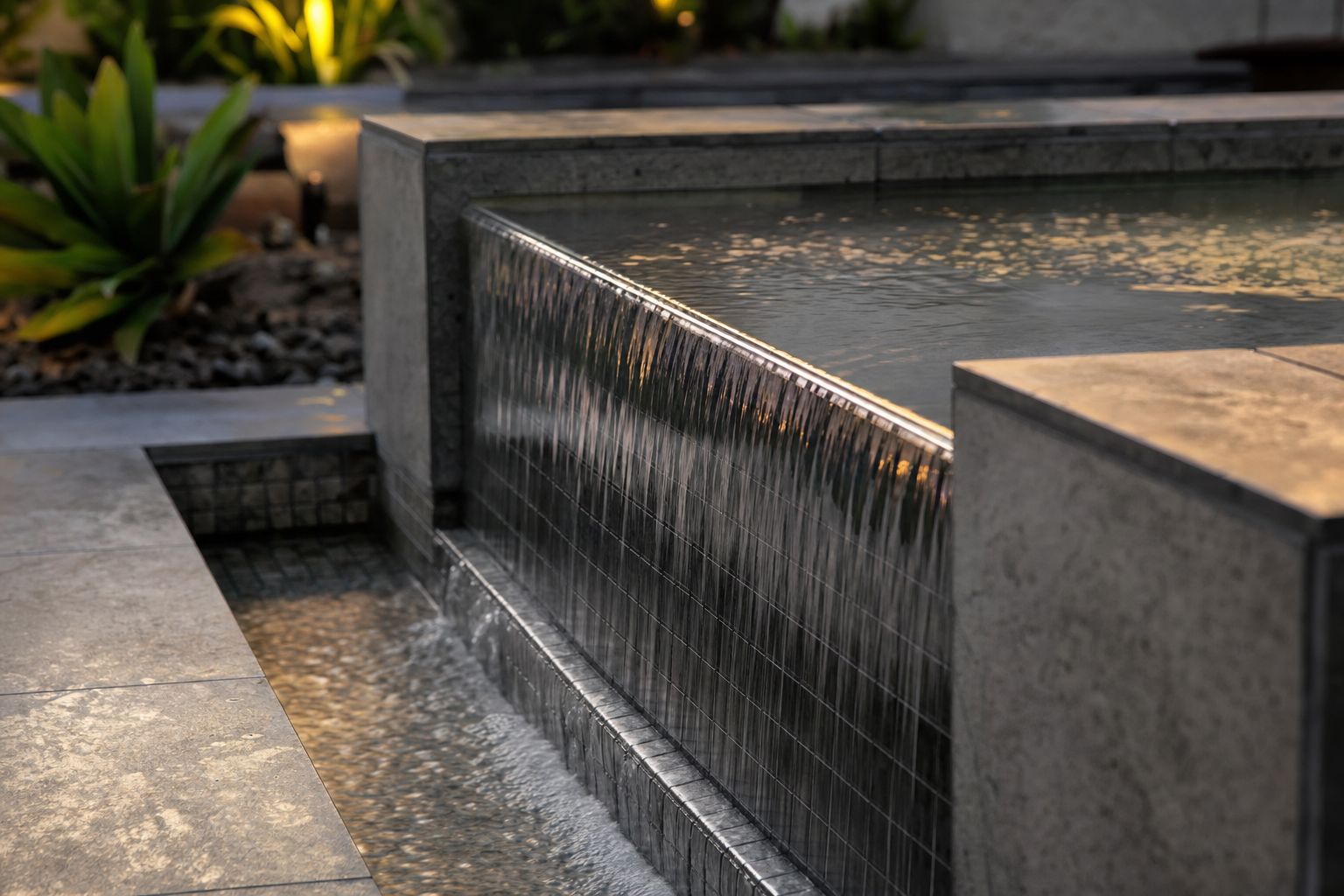
Infinity hot tub cost at a glance
Here’s what an overflow edge typically adds on top of a normal skimmer-based tub of the same size. These are the extras only, not the whole build.
| Extra item | Rough cost (US) | Rough cost (UK) |
|---|---|---|
| Infinity plans (instead of standard plans) | from $149 | from about £149 |
| Catch trough and balance tank structure (block/concrete, rebar, render) | $800–$2,500 | £600–£2,000 |
| Waterproofing both faces of the edge wall and the trough | $300–$900 | £250–£700 |
| Extra tiling (weir, outside face, trough) | $500–$2,000 | £400–£1,500 |
| Second pump (circulation/edge pump, ideally variable speed) | $700–$1,500 | £500–£1,200 |
| Extra pipework, valves, check valves and suction strainer | $300–$800 | £250–£600 |
| Automatic top-up and balance tank overflow | $250–$800 | £200–£650 |
| Electrical supply for the second pump (qualified electrician) | $200–$600 | £150–£500 |
| Typical extra over a skimmer tub | about $3,000–$9,000 | about £2,500–£7,000 |
To put that in context, a typical 8ft x 8ft DIY build comes in at around $9,000–$21,000 (about £6,000–£15,000) before the surround and heater. So an infinity edge usually adds something like a third to a half again on top. On a small tub the percentage is high because the trough and balance tank don’t shrink much with the tub.
Where the extra money goes
The catch trough and balance tank
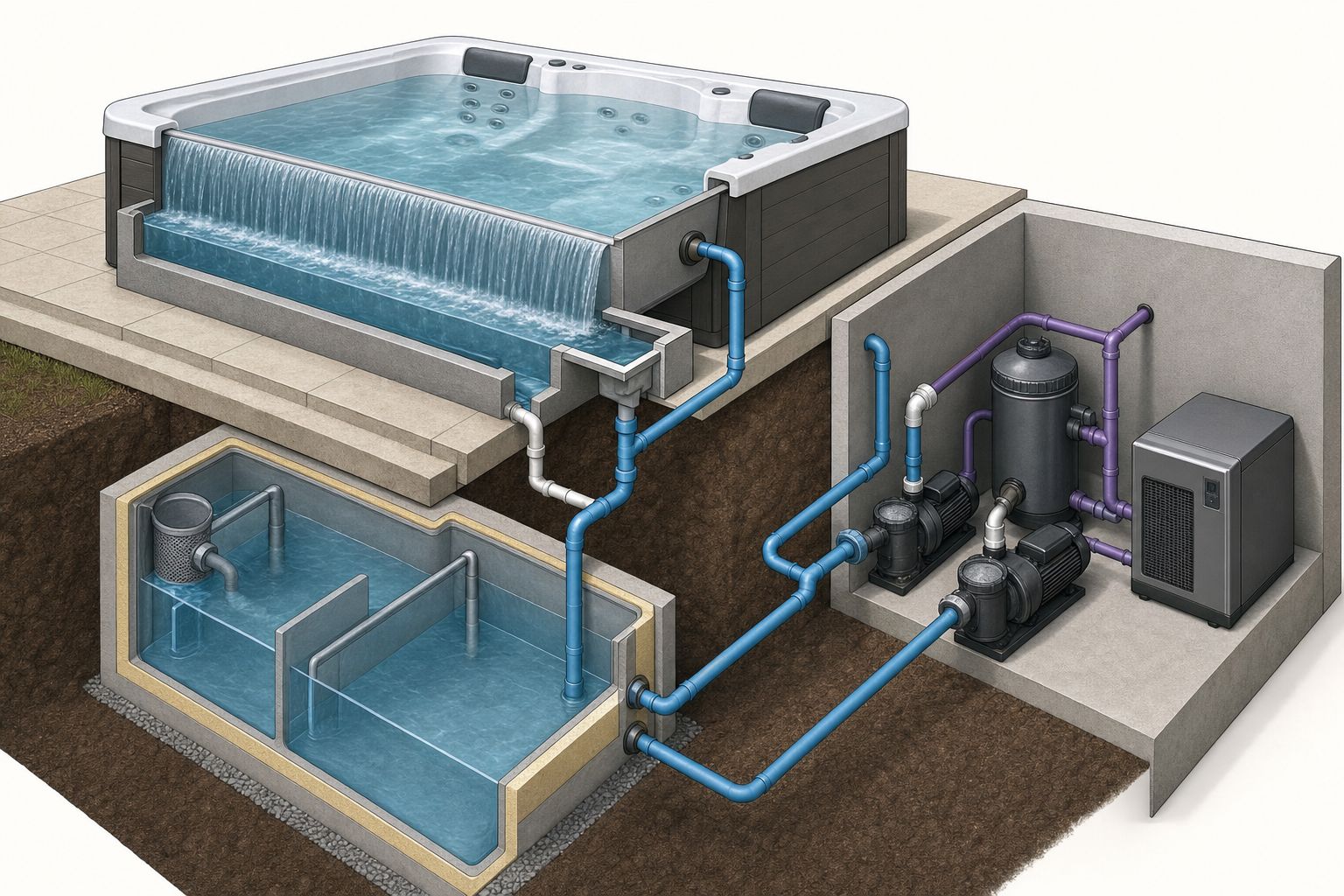
This is the biggest line. When water spills over the edge it has to land somewhere, and that somewhere has to hold a lot of water. As I explain in how to build a DIY infinity hot tub, each adult who gets in pushes out about 70 litres (about 18 US gallons). My rule of thumb is to work out the displacement for the maximum number of people and roughly double it, so an 8-person tub needs around 1,000 litres (about 260 US gallons) of balance capacity.
That’s a second, smaller structure, and it needs everything the main tub needs: a base, walls, reinforcement, render and waterproofing. You can build it as a separate buried tank, or, as in my infinity plans, make the overflow trough deep enough to double as the balance tank. Combining the two usually saves on digging and blockwork, because you’re building one structure rather than two, but it has to be designed in from the start.
A few people use a ready-made plastic tank as the balance tank. That can work, but it still needs a solid base, protection from ground pressure, insulation and access for cleaning, so the saving is often smaller than it looks.
Waterproofing and tiling on both sides
On a normal tub you waterproof and tile the inside. On an infinity tub the outside face of the edge wall and the inside of the trough are wet all the time, so they need the same treatment. That’s extra tanking, extra adhesive and grout, and more tiles, often in the most visible spot in the garden. It’s also fiddly work, so budget extra time if you’re tiling it yourself.
If you’d rather not tile a full waterfall face, a stainless steel water blade can form the spillway instead. That’s a different look and a separate cost, so price both before you decide.
The second pump
I always design infinity tubs with two pumps. The jet pump runs a closed loop from the main drains and back through the jets, so it doesn’t affect the edge at all. A second circulation pump draws from the balance tank, pushes the water through the filter and heater, and back into the tub, which is what sets the edge flowing. If you try to run the jets through the balance tank, you end up with far too much water going over the edge and a balance tank that has to be enormous.
A variable-speed pump costs more up front than a single-speed one, but it lets you turn the edge down to a quiet sheet at night, or off completely, and it’s cheaper to run. For an infinity tub I’d treat it as money well spent.
Pipework, valves and the top-up system
The extra plumbing isn’t expensive in itself, but it adds up: suction from the balance tank with a basket or strainer, check valves so the pipes don’t drain back and air-lock when the pump stops, an overflow from the balance tank to a drain, and a way to top it up automatically.
That top-up is worth getting right. A cheap float valve will keep topping up while the pump is running and the balance tank level drops, and then the excess runs straight out of the overflow when the pump stops. An electronic level controller with high and low points costs more but avoids that. I cover the options in my pool auto top-up guide. Whatever you choose, the mains feed needs an air gap or backflow protection, and your local water or plumbing regulations apply.
Electrics
A second pump, and possibly a level controller, means extra circuits or a bigger supply. This must be designed and installed by a qualified electrician, including the bonding and earthing, and local regulations apply. Get the electrician involved at the planning stage so the supply is sized for everything, not just a standard spa pack.
What an infinity edge adds to running costs
The build cost is a one-off. The running cost is every year, and it’s the part people forget to budget for.
- More water to heat. The water in the trough and balance tank has to be heated along with the tub. On an 8ft x 8ft tub that can be a big percentage increase in total volume.
- More heat loss. Water tumbling over an edge loses heat and evaporates faster than a still surface, and the balance tank loses heat through its walls if it isn’t insulated.
- A second pump running. A variable-speed pump on a low setting keeps this down, but it’s still another motor on the bill.
- More top-up water and chemicals. Extra evaporation means more top-up, which means more balancing of the water.
The way to keep this under control is the same as on any tub: insulate the walls, floor, trough and balance tank, fit a good cover, and turn the edge off when nobody is using the tub. With the edge off and the cover on, an infinity tub behaves much like a normal one. My post on the best way to heat a DIY hot tub covers heater choices, and the extra volume may push you up a size.
[ANDI: add your view or real figures on how much more an infinity tub costs to run per year compared with a skimmer tub]Where you can save, and where you can’t
Worth saving on
- One edge, not four. A perimeter overflow looks incredible, but it multiplies the trough, the tiling and the flow you need. A single edge facing the view gives most of the effect for a fraction of the cost.
- A shorter edge. Flow is roughly proportional to edge length (I work on about 5 gpm per foot, or roughly 60 litres a minute per metre, for a level edge). A 4ft edge needs less pump than an 8ft one.
- Combining the trough and balance tank. One structure instead of two, if it’s designed that way from day one.
- Simple large-format tiles on the outside face, if the edge isn’t the main view from the house.
Not worth saving on
- A level edge. Any low spot takes all the flow and leaves dry patches elsewhere. Check it with a laser or water level, and fix it before it’s tiled.
- Balance tank size. Too small and the pump sucks air when everyone climbs in, or the tank floods when the pump stops.
- Waterproofing. A leak behind tiles on the outside of the edge is a horrible job to fix.
- Check valves and access. Cheap to fit at the start, expensive to add once everything is set in concrete.
- Structure. If the edge sits on a slope or a raised wall, the loads need checking by a qualified structural engineer, and you may need permission or drawings depending on where you live.
If you want to see how other people have tackled it, have a look at Etienne’s infinity hot tub project and Doug’s infinity hot tub with a swim jet in Virginia.
Is the infinity edge worth the money?
I’ll be straight with you: if your tub sits on flat ground with a fence behind it, I’d probably spend that money on better tiles, insulation or a heat pump instead. An infinity edge earns its cost when there’s something to look at, such as a view, a slope down to the garden or a pool below for a spillover. Done well on the right site, it turns a hot tub into the centrepiece of the garden, and that’s where people tell me they don’t regret a penny.
It also suits people who are comfortable with a bit more plumbing complexity. It’s very achievable as a DIY project, but there’s more to get right, and the plans matter more than on a simple skimmer tub.
If you’re planning one, my infinity hot tub CAD plans are a dual-pump design with the overflow trough doubling as the balance tank. You get the architectural CAD drawings, plumbing diagrams, a shopping list, the assembly guide and the video course, in imperial sizes from 6ft to 12ft square and metric sizes from 183cm to 365cm. If your site is unusual, such as a slope, a raised build or a tub spilling into a pool, my Tub & Pool Designer Pro architectural CAD and plumbing design service draws the whole thing around your plot.
Infinity hot tub cost: FAQ
How much more does an infinity hot tub cost than a normal one?
For a DIY 8ft x 8ft (2.44m x 2.44m) tub with one overflow edge, expect roughly $3,000–$9,000 (about £2,500–£7,000) extra in 2026, mainly for the trough and balance tank, a second pump, extra plumbing, waterproofing and tiling. Prices vary by region.
Can I add an infinity edge to an existing hot tub?
It’s rarely practical. The edge wall has to be cut down perfectly level, a trough and balance tank built alongside, and the plumbing reworked for a second pump. In most cases it’s cheaper and better to design it in from the start.
Does an infinity hot tub cost more to run?
Yes. There’s more water to heat, more heat loss and evaporation from the falling water, and a second pump. Good insulation, a cover and turning the edge off when the tub isn’t in use make a big difference.
Do I need a balance tank for an infinity hot tub?
Yes. It holds the water pushed out when people get in, the water in transit over the edge and a reserve so the pump never runs dry. As a rule of thumb, allow about 70 litres (18 US gallons) per adult and roughly double it.
What’s the cheapest way to get an infinity look?
Keep it to one short edge facing the view, combine the trough with the balance tank, and use a variable-speed pump so you only run the edge when you want it.
Want the full drawings?
My Infinity Hot Tub CAD Plans include architectural drawings, dual-pump plumbing diagrams, a full shopping list, the assembly guide and video course, in imperial and metric sizes. Over 1,500 customers have used my plans and designs to plan their builds.