
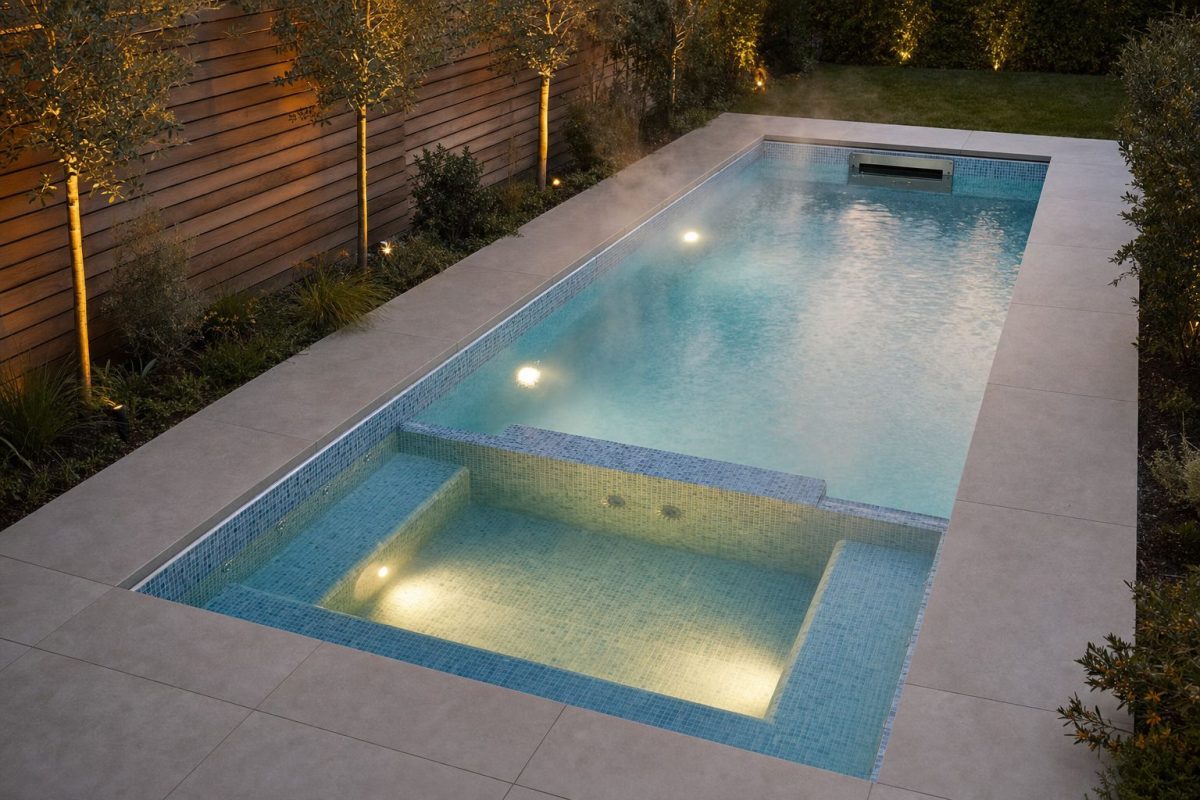
Swim spa size is the first thing to get right on a DIY build, because everything else follows from it: the swim jet, the dig, the water you heat, the weight on the slab and the cost. Get the length wrong and the current bounces off the back wall. Get the depth wrong and your hands scrape the floor on every stroke.
This guide covers sizing a swim spa you build yourself: length, width, depth, water volume and how much garden it really takes up, in feet and metres.
The short version
- Length: at least 14ft (about 4.3m) of swim lane for a counter current swim jet. 16–17ft (4.9–5.2m) is the sweet spot if you want seats as well.
- Width: 8ft (2.4m) is a sensible minimum for swimming. 9–10ft (2.7–3m) if you want more seating or a less cramped stroke.
- Water depth: roughly 42–51in (1.1–1.3m) is a good range for swimming and aqua exercise.
- Volume: a 16ft x 8ft swim spa with 4ft of water holds around 3,800 US gallons (about 14,500 litres). That’s five times or more the water of a typical hot tub.
- Footprint: the finished structure is bigger than the water, and you need room around it for the control room, the cover and access.
What swim spa size do shop-bought models come in?
Shop-bought swim spas give you a useful benchmark. According to HomeGuide, they range from about 10 to 21ft long and 5 to 10ft wide, are usually 3½–5ft deep and hold roughly 1,300–2,500 US gallons. Endless Pools, for example, lists models from 12ft to 20ft long, most of them 89in (about 2.26m) wide and 50–58in high. Sundance says swim spa heights typically run 50–60in, with deep models up to around 63in, and that the water depth is roughly 10in less than the height of the shell.
Those are external dimensions of an acrylic shell, so the water inside is smaller, and a factory model is limited by what fits on a lorry and through your side gate. A DIY swim spa is built in place, so you can make it the size your garden and your swimming actually need. More on buying versus building in Backyard swim spa: everything you need to know.
How long does a swim spa need to be?
Length matters most. If the pool is too short, the swim jet’s stream hits the far wall and comes back at you as a wave, so you swim in chop rather than a smooth current. The swim jet I sell needs a pool of at least 4m (14ft) for that reason, and I’d treat that as the floor, not the target.
Here’s how I’d think about length for a swim spa built from block or ICF:
| Internal length | What it’s good for |
|---|---|
| Under 14ft (4.3m) | Too short for a proper swim jet. Think plunge pool, cocktail pool or aqua exercise, not swimming. |
| 14–15ft (4.3–4.6m) | The minimum for a swim jet. Fine for steady recreational swimming and aqua fitness, but seating has to be kept compact. |
| 16–17ft (4.9–5.2m) | The sweet spot for most families: a clear swim lane plus a proper seating area at the other end. |
| 18–20ft (5.5–6.1m) | Taller or stronger swimmers, bigger seating areas, or a dual-zone layout with a separate hot tub section. |
Seats and steps at the far end shorten the lane you can actually swim in, so draw them in before you fix the length. And if you’re over about 6ft (1.83m), lean towards the longer end of the range. [ANDI: add your own advice here on what length you’d recommend for a tall or strong swimmer, based on customer feedback]
Still choosing the jet? Read Swim jet considerations first.
How wide should a swim spa be?
Width is about elbow room. Your arm span is roughly your height, so on breaststroke or a wide front crawl a 6ft (1.83m) swimmer needs most of 6ft of clear water just for their hands. An 8ft (2.4m) internal width leaves around a foot either side, which is why I’d call it the sensible minimum.
Going wider makes sense if you want more seating, two people exercising side by side, or the kids using it as a mini pool in summer. The trade-off is water. Every extra foot of width on a 16ft swim spa adds around 480 US gallons (about 1,800 litres) at 4ft deep to heat and treat. I wouldn’t go much past 10ft (3m) without a good reason.
How deep should a swim spa be?
For swimming, you need enough depth that your hands and feet don’t touch the floor through the stroke. For aqua jogging and water walking, you want the water somewhere around chest height on the main user. Those two needs land in a similar place: a water depth of roughly 42–51in (1.1–1.3m). That lines up with commercial swim spas too: H2X, for example, quotes about 42in of water on its standard model and about 51in on its deep model.
Deeper isn’t automatically better: it means a deeper dig, more spoil, more water and more pressure on the walls. For most families, around 4ft (1.2m) of water is the practical middle ground.
The swim jet has its own depth rule too: on the jet I sell, the nozzle sits about 250mm (10in) below the surface and the pump must be below the waterline.
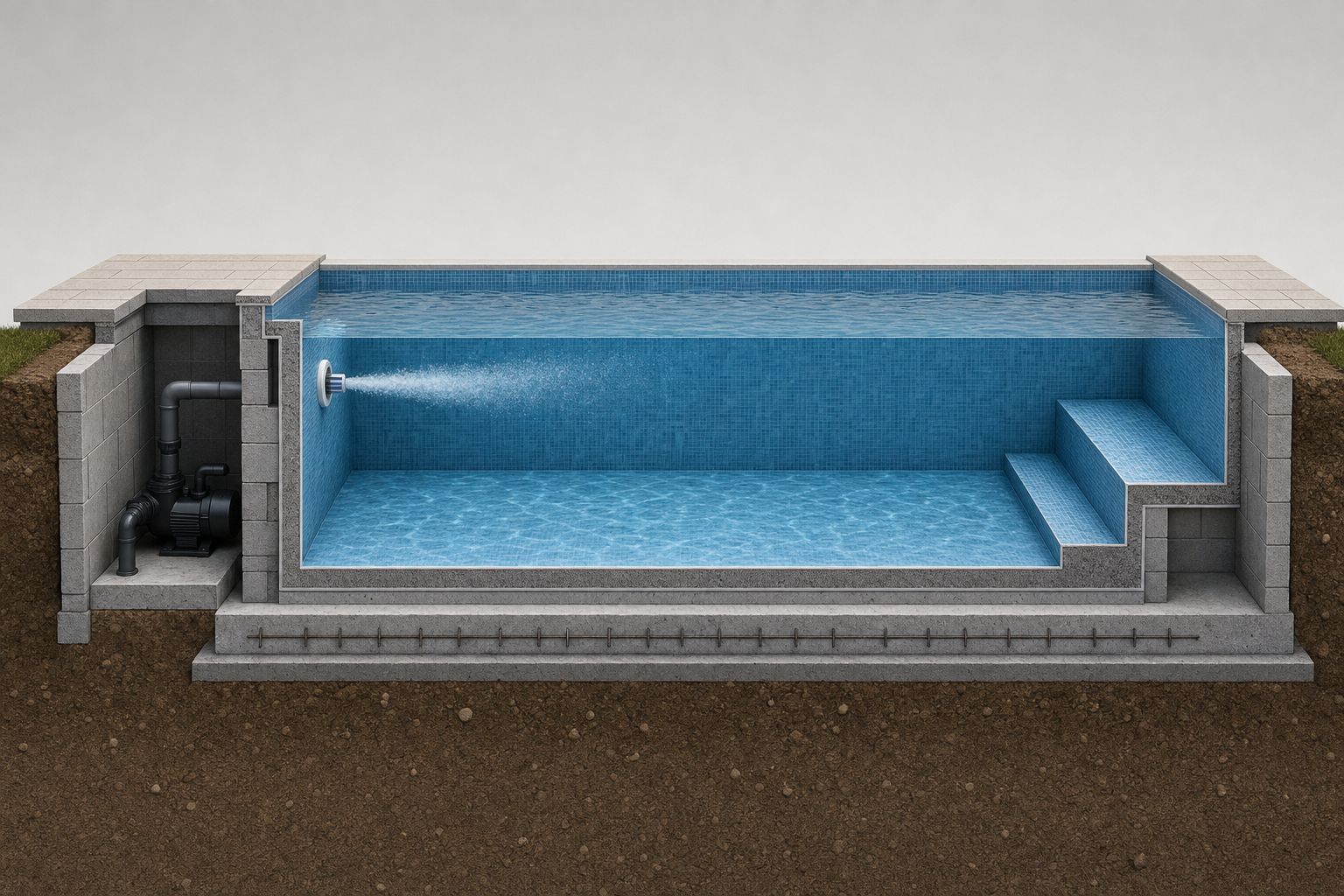
The hole is deeper than the water
The excavation is deeper than the water. Add the gap between the water and the top of the wall (the freeboard, set by your skimmer), plus the floor build-up underneath: sub-base, reinforced slab, render or membrane and tiles. [ANDI: add your typical freeboard and floor build-up figures here so readers can calculate the dig depth] I’ve explained the build-up in more detail in How to build a DIY exercise pool, and the same principles apply to any swim spa.
Swim spa dimensions and water volume
Once you know the internal length, width and water depth, the volume is simple maths:
- Imperial: length (ft) x width (ft) x water depth (ft) x 7.48 = US gallons.
- Metric: length (m) x width (m) x water depth (m) x 1,000 = litres.
Some worked examples, all at 4ft (1.22m) of water and before you subtract seats and steps:
| Internal size | US gallons (approx.) | Litres (approx.) |
|---|---|---|
| 14ft x 8ft (4.27 x 2.44m) | 3,350 | 12,700 |
| 16ft x 8ft (4.88 x 2.44m) | 3,830 | 14,500 |
| 17ft x 9ft (5.18 x 2.74m) | 4,580 | 17,300 |
| 20ft x 10ft (6.10 x 3.05m) | 5,980 | 22,700 |
Seats and steps take some of that out. Why it matters:
- Weight. A litre of water weighs a kilogram (a US gallon about 8.34lb), so 14,500 litres is around 14.5 tonnes (roughly 32,000lb) of water before you add the structure or the people. The slab and walls have to be designed for it, so have a structural engineer check the design for your ground conditions.
- Heating. A 3kW hot tub heater won’t keep up with this much water. Most people use an air source heat pump and a good insulated cover. See how to choose an air source heat pump.
- Filtration. Size the pump and filter to the real volume, not a hot tub’s.
Do you need a seating area or a separate hot tub zone?
There are two ways to do that.
Single zone with seating
One body of water, a swim lane at one end and bench seats with hot tub jets at the other. It’s the simplest to build, and how my swim spa plans are drawn: the swim jet, two steps down, and a 15-jet seating area. The catch is that it’s all one temperature, so you pick a compromise somewhere between swimming warm and soaking warm.
Dual zone
Two separate bodies of water side by side, usually a swim area kept at around 25–30°C (77–86°F) and a hot tub section at 37–40°C (98–104°F). It’s more comfortable, but it’s really two pools: two sets of filtration, two heating circuits and more structure. It also adds length, so plan on the 18ft-plus end of the range. If this is the direction you’re heading, my post on designing a plunge pool and hot tub combo covers the layout and plumbing decisions.
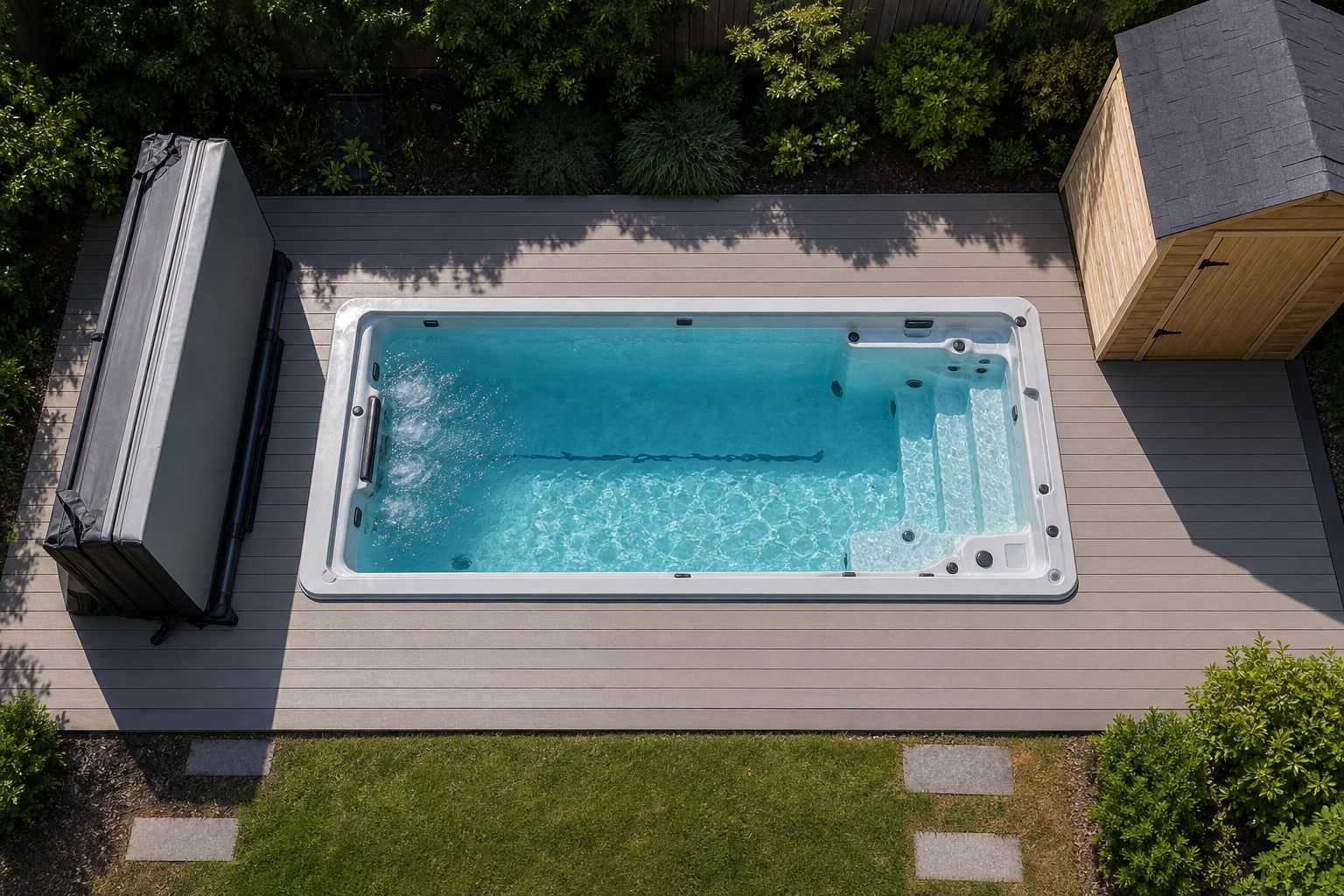
How much garden space does a swim spa take?
The water is only part of the footprint. Allow for:
- The walls. Block or ICF walls add to every side. On my 14ft x 8ft swim spa plan, for example, the total external dimensions are 228in x 112in (about 5.8m x 2.85m), because they include the walls and the space for the swim jet.
- A walkway round at least two sides for cleaning, the cover and safe access.
- Cover storage. Decide where a big cover lives when it’s off.
- The control room. The jet pump sits close to the jet and below the waterline, alongside the filter, heating and spa pack. Make it bigger than you think.
- Access for the dig. A mini digger and a route for the spoil, which on a swim spa is a lot of soil.
Electrics and rules also depend on size and location. In the UK a swim spa falls under BS 7671 Section 702 for the electrics, and the work is notifiable, so use a registered electrician. In the USA, expect a permit, NEC 680 bonding and, in most areas, a safety barrier. Local rules vary, so check yours before you fix the position, and always have a qualified electrician design and install the supply.
Choosing your swim spa size: a quick checklist
- Pick the swim jet and note its minimum length and nozzle depth.
- Decide who’s swimming and what seating you want.
- Fix the internal length, width and water depth.
- Work out the volume and size the heating, filtration and slab to it.
- Add walls, walkway, cover storage and control room, and check it fits.
If you’d rather start from proven dimensions than a blank sheet, my swim spa plans come in internal sizes from 14ft x 8ft up to 20ft x 10ft, each with the swim jet, seating and plumbing drawn out. For a bespoke size, there’s the Tub & Pool Designer Pro architectural CAD and plumbing design service. And if you haven’t picked a jet yet, here’s the counter current swim jet with pump I designed for DIY builds.
Want the full drawings?
My swim spa plans give you the dimensions, structural drawings, plumbing layout and shopping list for a swim spa with a counter current swim jet and a 15-jet seating area, in sizes from 14ft x 8ft to 20ft x 10ft. More than 1,500 customers have used my plans and guides to build their own.
FAQs
What is the minimum size for a swim spa?
For a counter current swim jet, at least 14ft (about 4.3m) of internal length and around 8ft (2.4m) of width. Shorter than that and the current bounces off the back wall.
How deep should a swim spa be?
Around 42–51in (1.1–1.3m) of water suits most people for swimming and aqua exercise. The excavation will be deeper once you add the freeboard and the floor build-up.
How many gallons does a swim spa hold?
Shop-bought models typically hold about 1,300–2,500 US gallons. A DIY swim spa of 16ft x 8ft with 4ft of water holds around 3,800 US gallons (about 14,500 litres), less the space taken by seats and steps.
Can I use a large hot tub as a swim spa?
Not really. Even a 12ft hot tub is too short for a proper current. I explain why in Can I use my hot tub as a swimming pool?
Got a question about sizing yours? Drop it in the comments below.
Cheers,
Andi