
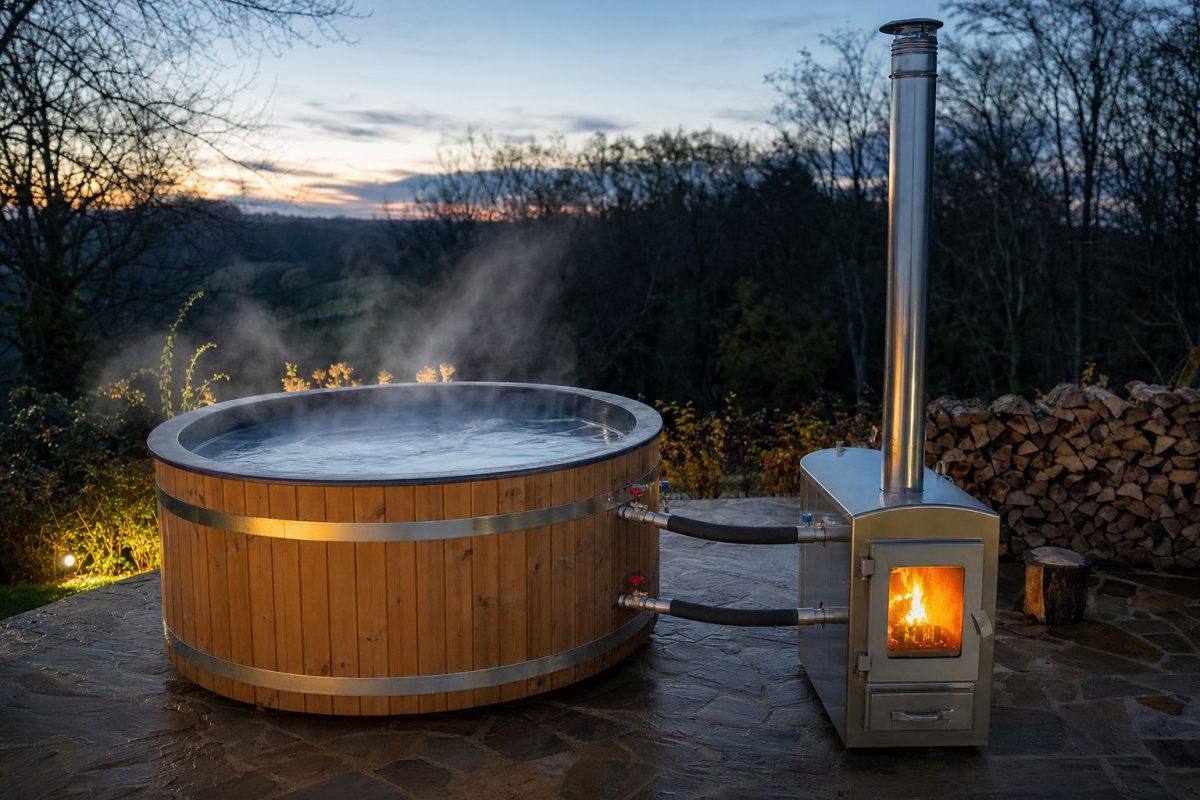
People often ask me about wood. A wood fired hot tub heater is cheap to buy, needs no mains supply and looks fantastic, but the type you choose changes how the whole tub works. In this post I’ll compare the three main options (internal stoves, external stoves and coils in a fire), what each does to your seating, plumbing and water, and which I’d pick for a DIY build.
One thing up front. If your tub has reliable power and gets used every week, I’d still fit an air source heat pump. Wood makes the most sense off-grid, or as a second heat source for the pleasure of it.
The short version
- Internal stove: simple and direct, but it takes up seating and puts hot metal in the tub with you.
- External stove: frees up the inside of the tub and is the style I’d choose for a timber tub.
- Coil in a fire: cheap and flexible, and it works well with a small pump as an auxiliary heater.
- No heater here has a thermostat. You are the thermostat, so stay at or below 40°C (104°F).
- Add a pump, filter and sanitiser, or you’ve got a bath you empty after each use.
How a wood fired hot tub heater works
The fire heats metal and the metal heats water. What differs is where the metal sits and what moves the water.
There are two ways to move it:
- Thermosiphon (convection). Hot water rises out of the heater and cooler water is drawn in behind it. There’s no pump and no electricity, but it’s gentle, so the water doesn’t mix well.
- Pumped. A small pump pushes water through the heater and back. It evens out the temperature, and it means you can put a filter in the loop. It does need some power.
On my weekend with a wood-fired tub, the heat stayed concentrated around the stove and the vents got hot enough to burn you. That’s thermosiphon heating with nothing to mix the water.
Option 1: the internal stove
An internal stove sits in the water, with the fire on the other side of a metal wall and usually a guard to stop you touching it. You feed it from above the water line, and the flue rises straight up from it.
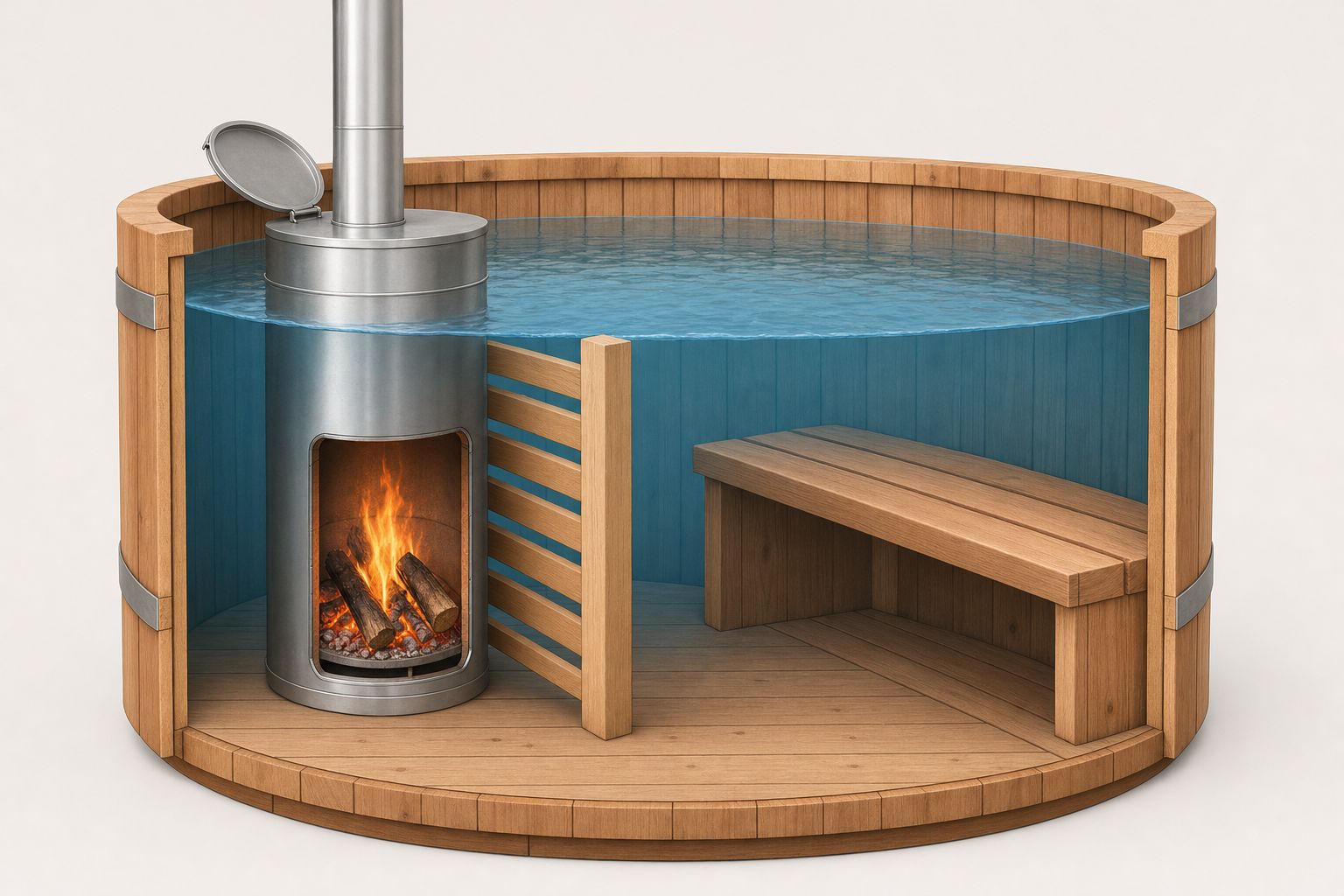
What’s good: nothing to plumb, no holes through the tub wall and very direct heating, because the water is all around the firebox.
What’s not: it takes up space where someone could sit, the hot surfaces are in the tub with the bathers, and the flue is right beside your head.
This is mainly a choice for traditional timber tubs and stock tanks. On a stock tank, follow the stove maker’s instructions to the letter, and check a poly tank’s temperature rating first. I wouldn’t put one in a block or concrete tub, where it would sit in the middle of your seats and footwell.
Option 2: the external stove
An external stove stands outside the tub, with a water jacket around the firebox. Two pipes connect it to the tub, one low and one higher up.
This is the style I’d choose if I were building a wooden tub. You keep the whole inside of the tub, you don’t handle ash over the water, and the heater is easy to reach for cleaning. A well-known example is the Chofu, which is around 9kW.
There are things to design for:
- Height. A thermosiphon relies on hot water rising, so the stove generally has to sit low relative to the tub’s water level, with both connections well under the water. Follow the maker’s figures.
- Distance. Short, direct pipe runs with no dips or high spots. Trapped air will stop a thermosiphon.
- The tub wall. You’ll need two watertight penetrations, in the right place and fitted with the connectors the maker specifies.
- A hot pipe. The return will be very hot where it enters the tub, so it needs a guard on the inside and protection on the outside.
For a sunken tub, the height rule is a problem. Stand a stove at ground level and it’s sitting above most of your water, so a thermosiphon won’t work without digging a pit for it. In that case, you’re looking at a pumped loop, which brings us to the third option.
Option 3: a coil in a fire
This one is exactly what it sounds like: a coil of metal pipe in a fire or fire pit, with water running through it and back to the tub. I’ve designed a couple of builds that used one. In most cases a small pump does the circulating.
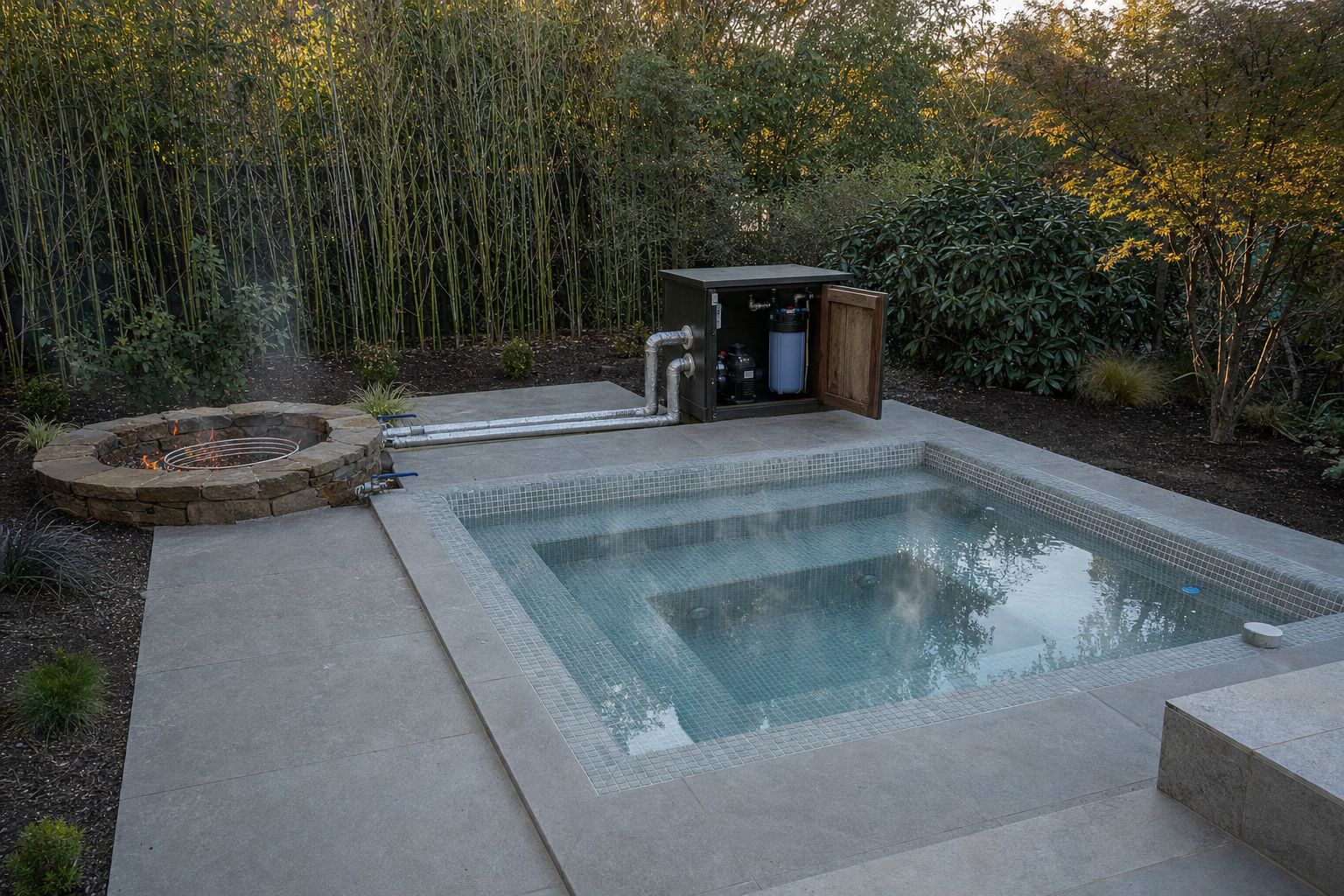
A coil is simple, the fire can be a feature of the garden, and the pump lets you add a filter and keep the water cleaner. As I said in my guide to heating a DIY hot tub, it’s hands-on, but it works well as an auxiliary heater.
It’s also the option that’s easiest to get dangerously wrong, so please read this carefully:
- Never shut off the flow with a fire lit. Water trapped in a hot coil turns to steam and pressure has nowhere to go. No closed valves, no blockages, and always a free path back to the tub.
- Plan for the pump stopping. A power cut means no flow through a coil in hot embers. A home-made coil isn’t a tested product, so take advice from a qualified heating engineer before you build one.
- Use metal near the heat. Standard PVC pressure pipe is generally rated to around 60°C (140°F), and a fire can easily beat that. Stainless or copper near the fire, with insulated runs, and only move to PVC once the water has cooled well below the limit.
How the three compare
| Internal stove | External stove | Coil in a fire | |
|---|---|---|---|
| Seating space | Loses some | Keeps it all | Keeps it all |
| Plumbing | None | Two connections | Pipework, usually a pump |
| Needs power? | No | No, but a pump helps | Usually |
| Sunken tub? | Not sensible | Pumped, or in a pit | Yes |
| Best for | Timber tubs, stock tanks | Timber and above-ground tubs | Second heat source on a DIY build |
Heat output and heat-up time
It takes about 1.16kWh to raise 1,000 litres (264 US gallons) by 1°C. So you can work out the energy for your own tub, then divide by the heater’s output. Here’s the sum for raising the water from 10°C to 38°C (50°F to 100°F), before any heat losses:
| Tub | Energy needed | At 9kW | At 20kW |
|---|---|---|---|
| 1,200 litres (317 US gal) | 39kWh | about 4¼ hours | about 2 hours |
| 2,200 litres (581 US gal), a typical 8ft x 8ft | 71kWh | about 8 hours | about 3½ hours |
Real life is slower. A fire doesn’t hold its peak output, and the tub loses heat all the way up. On that weekend, a warm tub went from 34°C to 39°C (93°F to 102°F) in about 50 minutes. From cold, we gave up after three hours.
Treat advertised figures with care, too. In November 2026, one US external stove kit is listed at about $900 (roughly £700) as equal to a 10–15kW electric heater, while a European kit at €941 (roughly £800) is sold as 39kW. Those numbers are unlikely to be measured the same way. Prices vary by region, so check before you buy.
The bit nobody puts in the brochure: control
None of these heaters has a thermostat. Keep feeding the fire and the water keeps getting hotter. The tub I tried reached 44°C (111°F), and the CDC says hot tub water shouldn’t go above 40°C (104°F).
- Keep a thermometer in the water the whole time.
- Stop adding wood at around 37–38°C (99–100°F). The stove keeps giving out heat for a while after.
- Close down the air supply as you get close.
- If it overshoots, take the lid off or add cold water.
- Never light a stove with the tub empty, and keep the water well above the stove’s surface.
Adding filtration (and a spa pack)
Most of the problems with wood-fired tubs come from having no filtration or sanitiser, not from the fire. The tub I tried stank by the next morning.
If you have any power at all, add a small circulation pump, a filter and a proper sanitiser. My cedar hot tub plumbing kit gives you a circulation pump, a cartridge filter and a Balboa spa pack with a thermostatic heater, and a wood heater can then be your second heat source on its own separate loop. With no mains at all, my off-grid hot tub guide goes through what a small solar setup can realistically run.
Anything electrical beside a hot tub needs a qualified electrician: a dedicated circuit, RCD protection in the UK or GFCI in the USA, and any bonding your local regulations require. That goes for a small pump as well as a full spa pack. Local regulations apply and they vary.
Safety and the rules
- Smoke. In a UK smoke control area, wood can only be burned in exempt appliances, so check with your council before you buy. In the USA, check local burn rules and any HOA restrictions.
- Flue and clearances. Follow the maker’s distances to anything that can burn, including fences, decking, cladding and hedges. Don’t put a stove under a pergola or gazebo, or close to a building, without advice from a qualified stove or chimney installer and your local building control.
- Carbon monoxide. A wood fire belongs in the open air. Never run one in an enclosed space.
- Structure. A stove full of water is heavy. Stand it on a solid, non-combustible base, and on a raised deck or anything unusual, ask a structural engineer.
- Children. Guard the stove, flue and hot pipes, and never leave a fire unattended.
- Frost. Water left in a stove or coil can freeze and split it, so drain it down if it’s going to be left in freezing weather.

Which one would I choose?
For a timber tub, external. For a block, ICF or concrete DIY tub with power, I’d fit a heat pump and spa pack first, and only add a pumped wood loop if I wanted the fire for its own sake. Design that loop in early, before the tub is built. You can try your layout free in Tub & Pool Designer Pro, and if you’d like a second pair of eyes on the pipework, my plumbing consultancy is there for exactly that.
FAQs
Is an internal or external wood-fired heater better?
For most DIY tubs, external. You keep your seating and your hot metal stays out of the tub. An internal stove is simpler, with nothing to plumb, so it can suit a traditional timber tub.
Can I use PVC pipe with a wood-fired heater?
Not near the heat. Standard PVC is generally rated to about 60°C (140°F). Use metal or the maker’s specified heat-resistant connections around the stove or coil.
Can I run a wood heater and a spa pack together?
Yes, as a separate heating loop, with its own suction and return, designed in from the start. Your spa pack keeps running the pumps, filtration and controls.
Want the full drawings?
My CAD-based Hot Tub Plans come in 21 sizes, with the plumbing layout and shopping list worked out, so you can decide where a second heating loop goes before you dig. Want something bespoke? Take a look at Tub & Pool Designer Pro, my architectural CAD and plumbing design service.
Have you built a wood-fired tub? I’d love to hear how you got on in the comments below.
Cheers,
Andi