
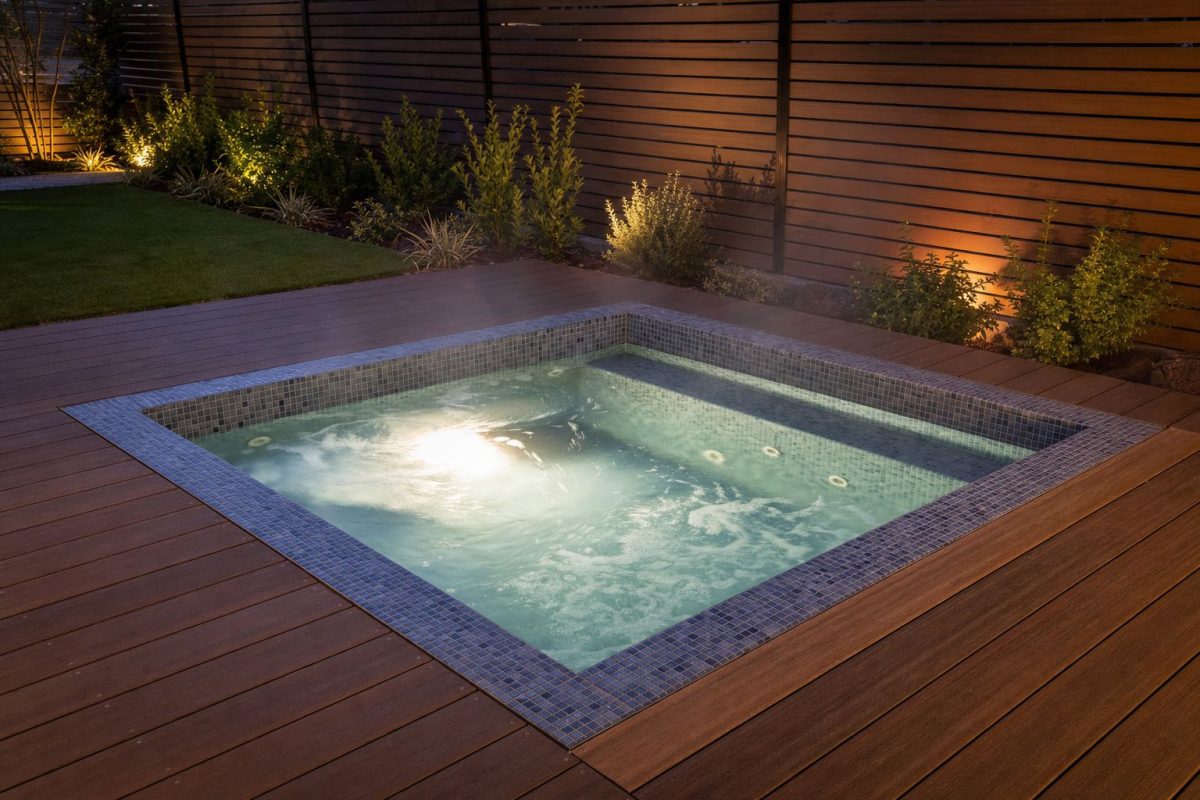
“How big should I make it?” is usually the first question people ask me when they decide to build their own tub, and it shapes everything that follows: the dig, materials, plumbing, heater and running costs. Get the hot tub sizes question right and the rest of the build falls into place. Get it wrong and you end up with a cramped tub, or a big pool of lukewarm water that costs a fortune to heat.
In this post I’ll walk through how I’d think about size if I were starting again: how many people it really needs to seat, how much water that means, what that does to heating and pumps, and how much space you need around it. Figures are in both imperial and metric throughout.
Hot tub sizes at a glance
Retail spas are sold by “number of seats”, but a DIY tub is different. You’re usually building a square or rectangular shell with a bench seat running around the inside and a deeper footwell in the middle, so the useful measure is bench length rather than moulded seats. As a rough guide, allow about 24in (60cm) of bench per adult, a little more if people like to stretch out.
Here’s how the common DIY sizes work out. These are internal dimensions, with a typical water depth of around 3ft 3in (1m) and an 18in (45cm) bench. Treat the volumes as ballpark figures; your exact depth and bench design will change them.
| Internal size | Comfortable seating | Approx. water volume |
|---|---|---|
| 6ft x 6ft (1.83m x 1.83m) | 3–4 adults | ~590 US gal (~2,200 L) |
| 7ft x 7ft (2.13m x 2.13m) | 4–5 adults | ~840 US gal (~3,200 L) |
| 8ft x 8ft (2.44m x 2.44m) | 5–6 adults | ~1,150 US gal (~4,300 L) |
| 10ft x 10ft (3.05m x 3.05m) | 7–8 adults | ~1,900 US gal (~7,200 L) |
| 12ft x 12ft (3.66m x 3.66m) | 9–10 adults | ~2,850 US gal (~10,800 L) |
Shop-bought acrylic spas of 6–9ft (1.8–2.7m) hold less water, because moulded seats fill much of the shell. A built-in tub of the same footprint usually holds more water, which you have to plan for when you choose a heater.
Start with how you’ll actually use it
The biggest mistake I see is sizing the tub for the one party a year rather than the other 364 evenings. Be honest with yourself about these questions:
- Who uses it most nights? If it’s mostly two of you, a 6ft or 7ft tub will feel cosy, heat quickly and cost less to run.
- How often do you have guests? If the family plus a couple of friends is a regular thing, 8ft x 8ft is the sweet spot. It’s no accident that it’s my best-selling plan.
- Do you want to lie down? A lounger along one side takes up the space of two seated people, so size up if you want one.
If you’re torn between two sizes, I’d generally go with the smaller one and spend the difference on better insulation, a better cover and a better finish. You’ll use a tub that’s hot and ready far more than one that’s big and slow.
Square or rectangular?
Square tubs are the most sociable because everyone faces inwards and the corners make natural seats. Rectangles such as 8ft x 6ft or 10ft x 7ft suit narrow gardens and side returns, and they’re the natural shape if you want a lounger along one end.
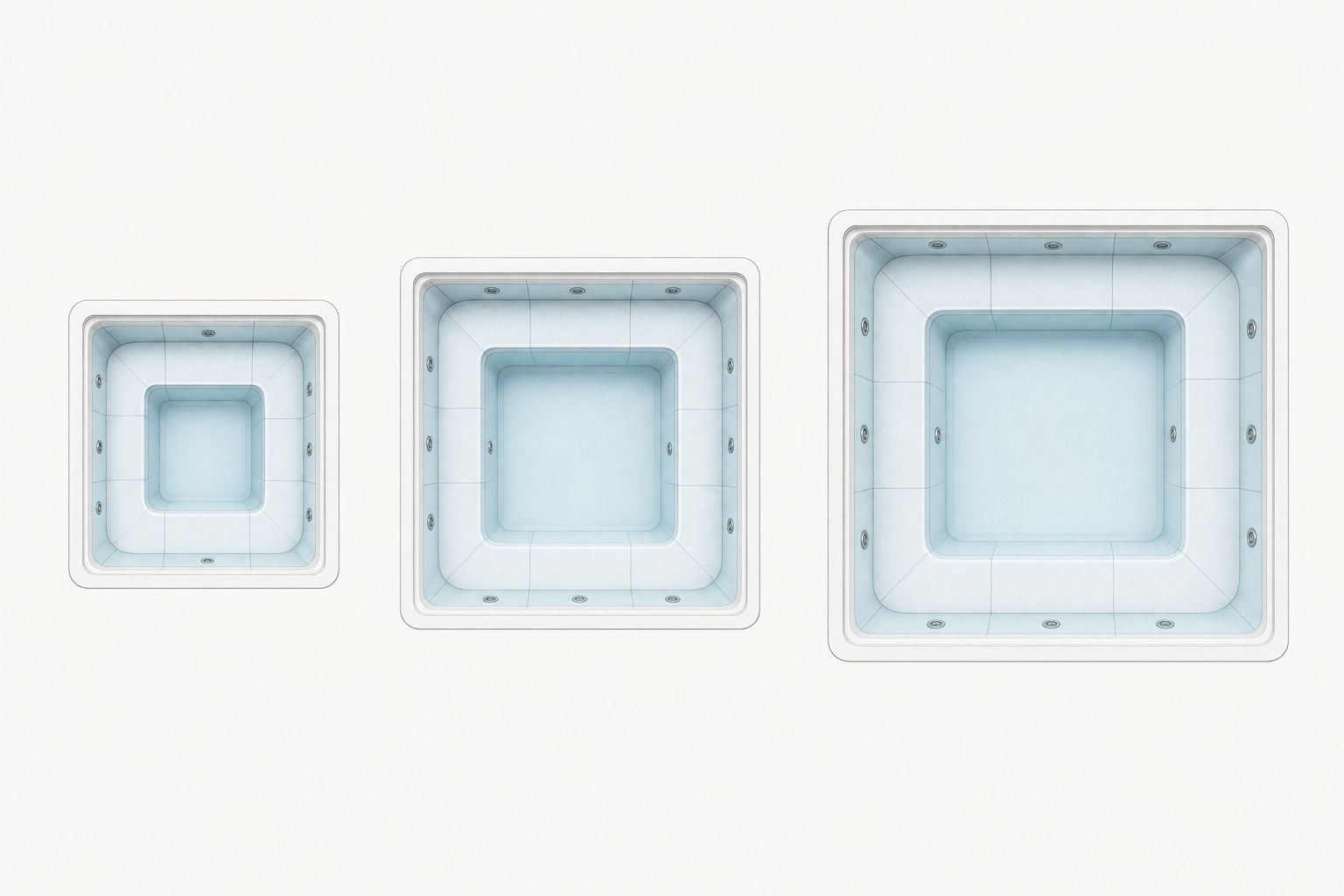
Depth, seats and footwell
Footprint gets all the attention, but depth decides whether the tub is comfortable. What you’re after is water around shoulder height when seated, with enough room in the footwell to stand and move about without banging shins on the bench.
- Water depth: many built-in tubs land somewhere around 3ft to 3ft 6in (0.9–1.07m) in the footwell. Deeper than that and shorter bathers end up floating off the bench.
- Bench height: roughly 16–20in (40–50cm) up from the footwell floor works for most adults. Varying the heights slightly around the tub helps people of different sizes find a comfortable spot.
- Bench depth: around 18in (45cm) front to back is comfortable to sit on and leaves room for jets in the wall behind.
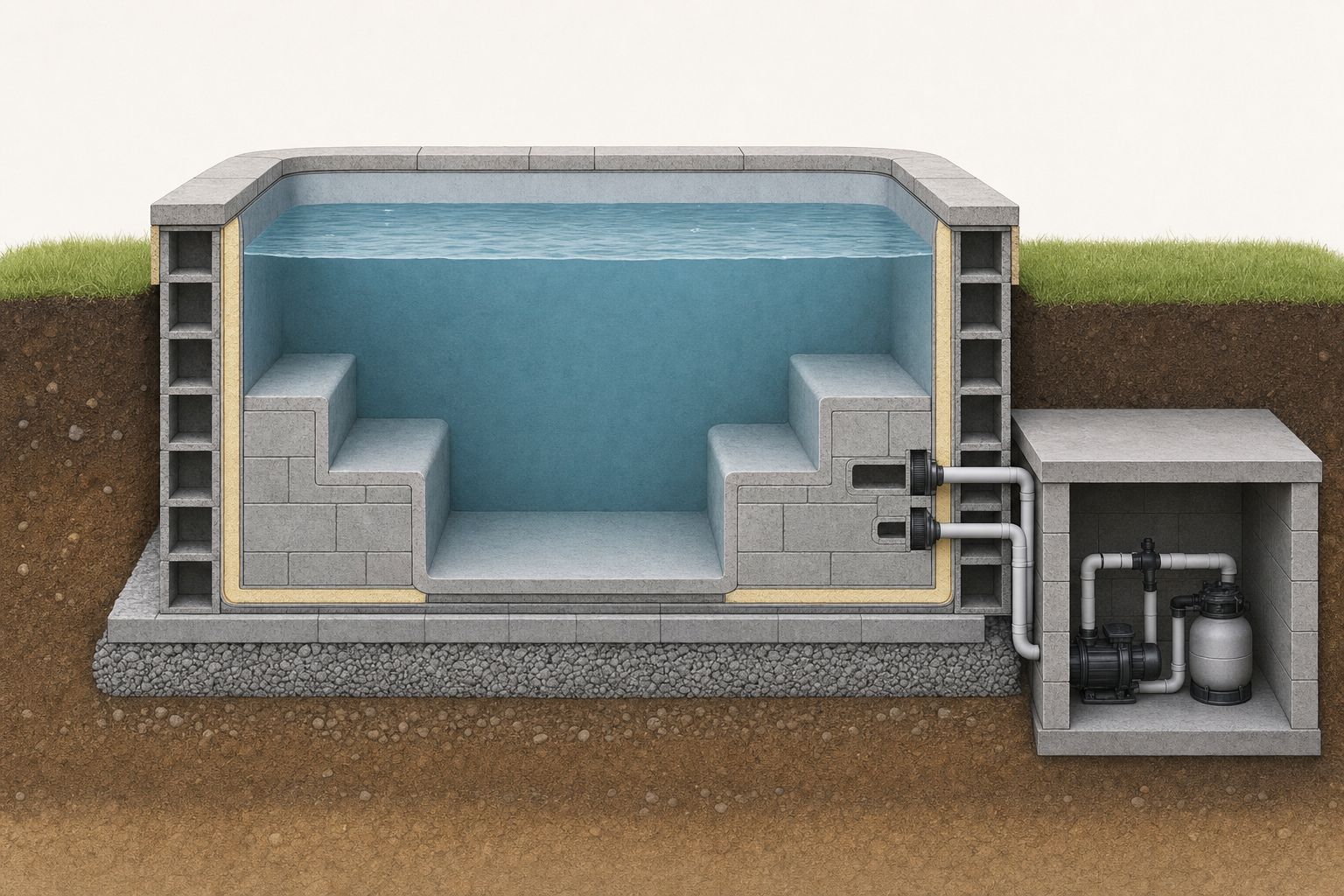
Remember that the depth you dig isn’t the water depth. You also need room for the sub-base, slab, insulation, render, waterproofing and tiles, which I cover step by step in my DIY in-ground hot tub build guide.
Water volume: why size drives your running costs
Every extra foot of width adds a surprising amount of water. Going from 8ft x 8ft to 10ft x 10ft looks like a modest step on paper, but in the example above it takes you from roughly 1,150 to 1,900 US gallons (4,300 to 7,200 litres). That’s about 65% more water to heat, filter and treat.
How to work out your own volume
Here’s the quick way to get close:
- Multiply internal length x width x water depth. In feet, multiply the answer by 7.48 to get US gallons. In metres, multiply by 1,000 to get litres.
- Work out the volume of the bench (its width x height x the length it runs around the tub) and take that off.
- Take off a little more for steps or loungers if you have them.
Your volume feeds straight into heater size and chemical dosing, so it’s worth doing properly.
What it means for heating
The physics is simple: it takes about 1 BTU to raise 1lb of water by 1°F, or about 1.16 watt-hours to raise 1 litre by 1°C. Ignoring heat loss (which is never zero in the real world), that gives these rough heat-up rates for the 8ft x 8ft example at around 4,300 litres:
- A 3kW heater, common on UK spa packs, adds roughly 0.6°C (1.1°F) per hour.
- A 5.5kW heater, common on US 240V spa packs, adds roughly 1.1°C (2°F) per hour.
Double the water and you roughly halve those figures. That’s why I always tell people that size and heating have to be decided together. A bigger tub often needs a bigger heater, an air source heat pump, or gas, and every one of those has knock-on effects for your electrical supply and budget. My heater size guide and calculator will let you plug in your own volume.
Whatever you choose, the heater and electrical supply must be specified and installed by a qualified electrician (or a Gas Safe or licensed gas engineer for gas), and local regulations apply. Most codes and safety bodies also cap hot tub water at 104°F (40°C), so a bigger tub doesn’t mean hotter water, just more of it.
Pumps, jets and hot tub sizes
A bigger tub doesn’t automatically need more jets, but people usually want them because there are more seats to serve. My rule of thumb is a maximum of 16 jets per pump; beyond that you need a second pump rather than a bigger one. Sixteen is plenty for an 8ft x 8ft or 10ft x 10ft tub if the jets are placed where people actually sit.
Going above 10ft x 10ft, or adding a lounger or water feature? Read how many pumps you need for a DIY hot tub first.
Space around the tub
The footprint of the water is only part of the story. Before you choose hot tub dimensions, mark out the whole area in the garden with string or spray paint and live with it for a few days. You’ll need room for:
- The walls themselves. Block or ICF walls add several inches (and usually well over 10cm) on every side, so a tub with 8ft internal dimensions has a noticeably larger external footprint.
- The control room. Keep it close (I suggest within 15–20ft, about 4.5–6m) and below the water line, and make it bigger than you think you need. I learned that one the hard way.
- Getting in and out. Steps, a handrail and somewhere dry to stand.
- The cover. A folding cover needs somewhere to go when it’s off, and a larger cover is heavier to handle.
Weight matters too. Water weighs about 8.34lb per US gallon (1kg per litre), so the 8ft x 8ft example holds roughly 9,500lb (4.3 tonnes) of water before anyone gets in. For an in-ground tub on good ground that’s usually manageable, but if you’re thinking of building on a deck, a roof terrace or anywhere raised, you need a structural engineer to check the loads. Planning or permit rules can also change with size, so check what applies where you live; my post on whether you need a permit for your hot tub is a good starting point.
Small or big?
If you’ve got a tight courtyard, a smaller budget, or it’s mainly for two, a 6ft x 6ft or 7ft x 7ft tub heats faster, costs less to run and needs less material (more in a small hot tub for a small backyard). Go to 10ft x 10ft or beyond if you regularly have six or more in it or want a lounger plus a full ring of seats, but go in with your eyes open on heating, pumps and cover weight.
Choosing your size with proper plans
Once you have a size in mind, the next step is turning it into a set of drawings you can actually build from. My DIY hot tub plans come in 21 sizes, from compact 6ft x 6ft and 7ft x 7ft tubs up to 12ft x 12ft, in imperial and metric (such as 2.13m and 2.44m square). Each set is drawn in CAD with the dimensions, plumbing layout and shopping list worked out for that size. If you’re not sure where to start, the 8ft x 8ft hot tub plans are the most popular choice for a reason.
If your space is awkward, or you want something none of the standard sizes cover, my Tub & Pool Designer Pro architectural CAD and plumbing design service will draw a bespoke tub around your site. You can also read my key considerations for building a DIY hot tub in 2026 for the other decisions to make alongside size.
FAQ
What is the most popular hot tub size to build?
For DIY builds, 8ft x 8ft (about 2.44m x 2.44m) is the most popular. It seats five or six adults comfortably, fits most gardens and is still reasonable to heat.
How many gallons is an 8ft x 8ft hot tub?
It depends on depth and bench design, but a built-in 8ft x 8ft tub with around 3ft 3in (1m) of water and an 18in bench holds roughly 1,100–1,200 US gallons (about 4,200–4,400 litres).
How much space do I need per person?
Allow around 24in (60cm) of bench per adult. Loungers take up about the space of two seated people.
Is a bigger hot tub more expensive to run?
Generally, yes. More water means more energy to heat it and keep it hot, more chemicals, and often a bigger heater or a heat pump.
How deep should a DIY hot tub be?
Many built-in tubs have around 3ft to 3ft 6in (0.9–1.07m) of water in the footwell, with benches 16–20in (40–50cm) high. Aim for water around shoulder height when seated.
Found your size? Get the full drawings
My CAD-drawn hot tub plans come in 21 sizes, imperial and metric, with the dimensions, plumbing layout, shopping list and step-by-step instructions for your chosen size. Join my 1,500+ customers building their own tubs and pools.