
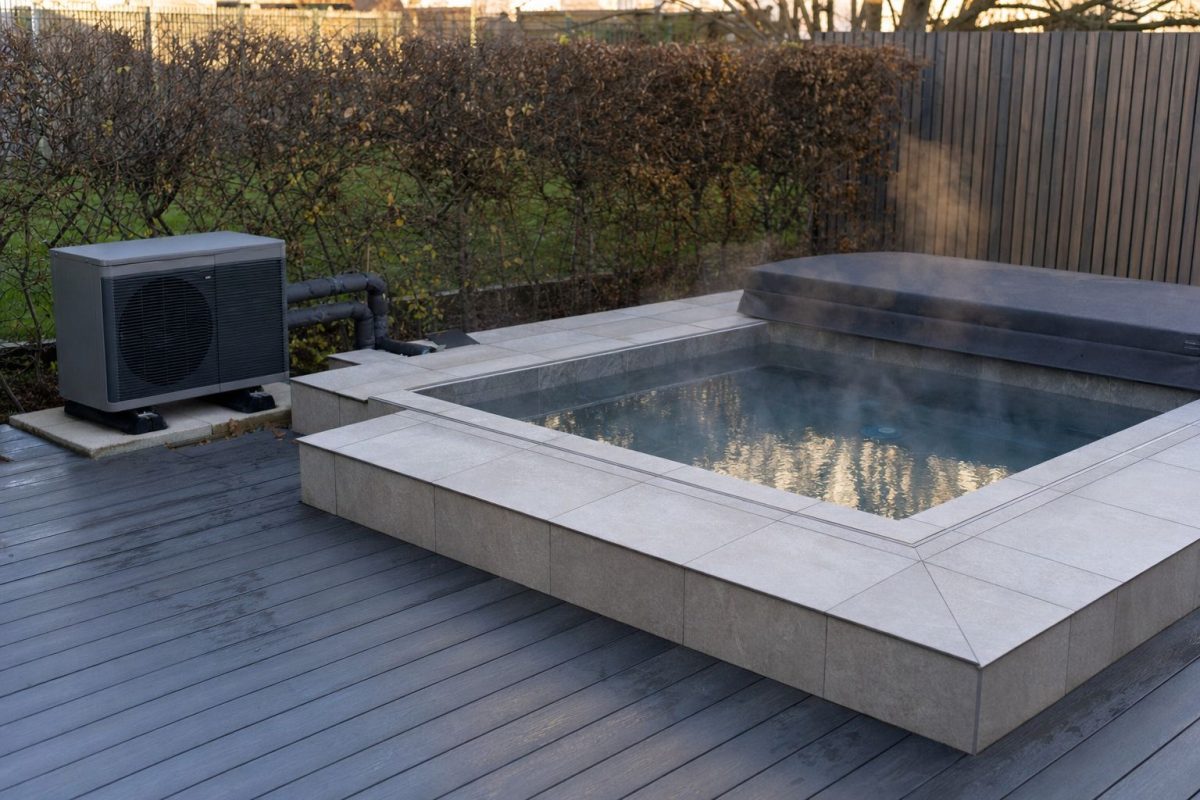
If you’ve been shopping for a heat pump for your hot tub, you’ll have seen two refrigerants on the spec sheets: R32 and R290. Until recently nobody cared what gas was inside the box. Now it matters, because the rules on refrigerants are changing, and which one you pick can affect what you can buy, who can service it and where you can put it. This is my plain-English take on R32 vs R290 for a DIY hot tub, with the regulations as they stand in November 2026.
The short version: both work well, R32 isn’t banned in Great Britain or the US, and R290 is where most manufacturers are heading. The details below should help you decide which suits your build.

What the refrigerant actually does
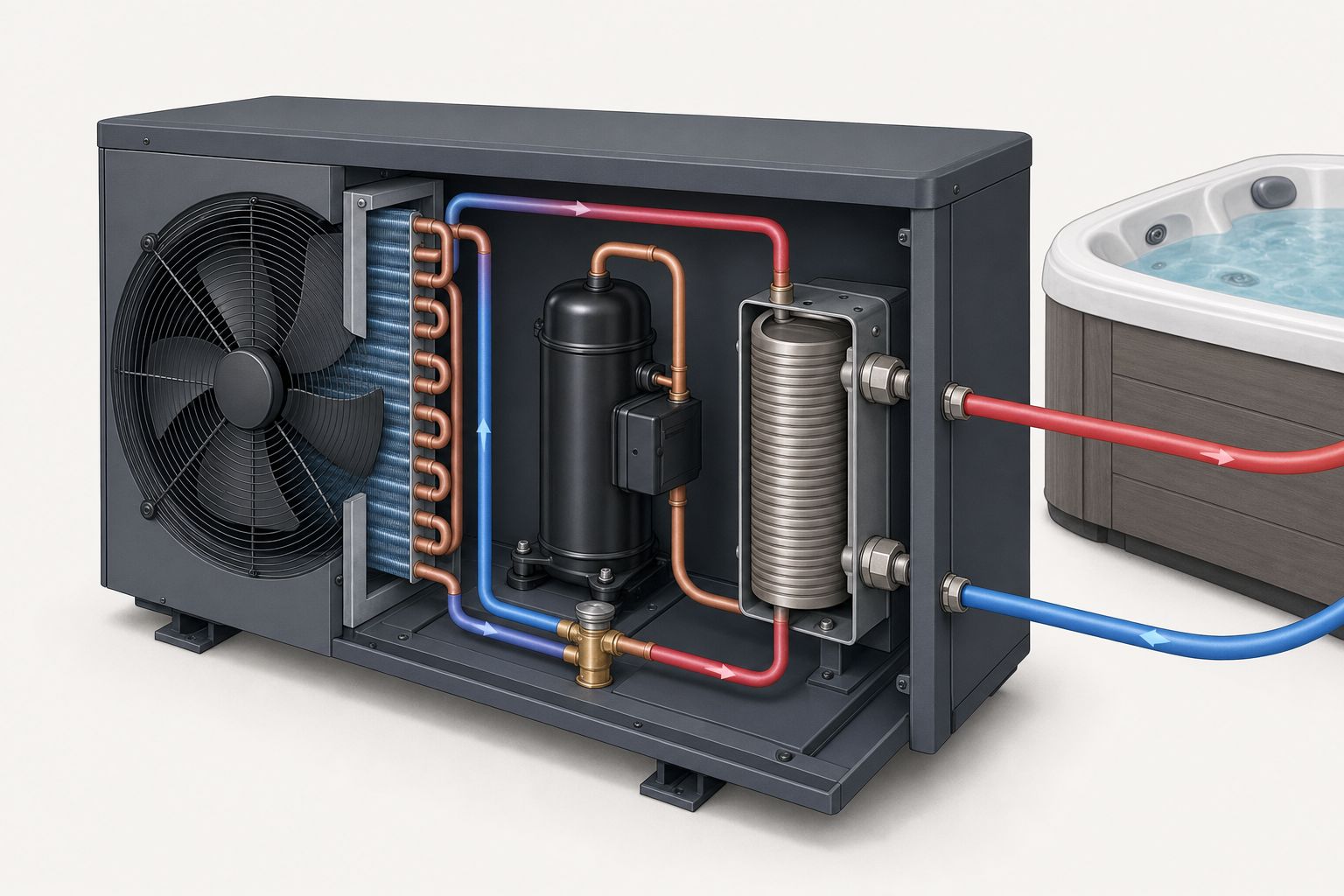
A heat pump doesn’t make heat. It moves it. Refrigerant in a sealed loop boils in the outdoor coil, picking up heat from the air even on a cool day. The compressor squeezes that gas so it gets much hotter, and the heat passes through a titanium heat exchanger into your hot tub water. The refrigerant condenses, goes through an expansion valve and starts again. I explain the whole cycle in my complete guide to air source heat pumps for hot tubs.
Nearly every hot tub and pool heat pump is a monobloc unit. All of the refrigerant pipework is built and sealed in the factory, and you only connect water pipes and power on site. That matters, because monobloc (or “self-contained”) units are exactly what the new rules target.
R32 vs R290: the key differences
R32
R32 (difluoromethane) is what most hot tub heat pumps sold over the last few years use, including the Comfortline I cover in my Comfortline heat pump review. It replaced R410A, which has a global warming potential (GWP) of around 2,088. R32’s GWP is 675, so it was a big step forward. It’s efficient, well understood and every refrigeration engineer knows how to handle it. It’s classed A2L, meaning mildly flammable.
The catch is that 675 is still a fluorinated gas with a significant warming effect if it leaks. That’s why it’s caught by the newest European rules.
R290
R290 is refrigerant-grade propane. It’s a natural refrigerant with a GWP of about 3 on the figures most spec sheets use, and close to zero on the latest ones. It isn’t a fluorinated gas at all, so F-gas bans don’t touch it. It’s a very good refrigerant: it works well in cold weather and can reach high water temperatures, which is why domestic heating heat pumps have been moving to it.
The trade-off is flammability. R290 is classed A3, highly flammable. The charge inside a hot tub heat pump is small and sealed, and units are designed and tested for it, but it changes where you can put the unit and who should work on it. I cover that below.
Side by side
- Global warming potential: R32 675; R290 about 3.
- Safety class: R32 A2L (mildly flammable); R290 A3 (highly flammable).
- Regulation: R32 is restricted in new monobloc units in the EU and Northern Ireland from 2027; R290 isn’t affected by F-gas bans.
- Performance: both are excellent for holding a hot tub at 37–40°C (99–104°F). The design of the unit matters far more than the gas.
- Servicing: R32 can be handled by any F-gas certified engineer; R290 needs an engineer trained in hydrocarbon refrigerants.
- Siting: R290 units come with stricter clearance rules. Always follow the manufacturer’s installation manual.
The rules in 2026: what’s changing and where
EU and Northern Ireland: the 2027 ban
The EU’s F-gas Regulation (EU) 2024/573 says that from 1 January 2027, self-contained (monobloc) heat pumps up to 12kW that use a fluorinated gas with a GWP of 150 or more can no longer be placed on the market, unless a lower-GWP gas can’t meet the site’s safety requirements. Monobloc units from 12kW up to 50kW are caught from the same date. From 2032 the rule tightens again: self-contained units up to 12kW can’t contain any F-gas at all.
R32 at 675 is well over 150, and most hot tub heat pumps sit in the 5–12kW range. In practice, if you’re in the EU, expect new R32 hot tub heat pumps to disappear from the shelves from 2027 and R290 models to take their place. Under the Windsor Framework, the EU F-gas rules also apply in Northern Ireland.
Great Britain: no ban (yet)
England, Scotland and Wales still use their own retained version of the older F-gas rules and have not adopted the 2027 monobloc ban. Defra consulted on reforming the GB rules in 2025 and said in May 2026 that it would not legislate on changes during 2026. As I write this in November 2026, there’s no date for a GB ban on R32 in hot tub heat pumps. That could change, so check the “F-gas bans in new products” guidance on GOV.UK before you buy.
So in GB you can still legally buy and install an R32 hot tub heat pump.
USA
The US is on a different path. Under the AIM Act, the EPA set a 700 GWP limit for most new residential and light commercial air conditioning and heat pump equipment from 2025, which is why R410A is being phased out. R32 (675) sits under that limit, so it’s one of the main replacement gases in the US rather than one being banned. R290 pool and spa heat pumps exist but are less common. Rules change and vary by state, so check with your supplier.
What about the heat pump you already have?
These are rules about what can be sold new. They don’t make you remove a working heat pump, and an existing R32 unit can still be used, repaired and re-gassed by a qualified engineer. If your Comfortline or any other R32 unit is running well, there’s no reason to replace it because of the refrigerant.
Which should you choose for your DIY hot tub?
If you’re in the EU or Northern Ireland
Go R290. From 2027 it’s likely to be most of what’s offered, and buying R32 now means a unit that’s on its way out. Make sure you plan the siting around R290’s clearance rules from the start.
If you’re in England, Scotland or Wales
You have a real choice. A good R32 inverter heat pump is still a sensible buy: efficient, widely available and easy to get serviced. R290 is the more future-proof option, and manufacturers that sell into Europe will put their development effort there. If an R290 model and an R32 model are close in price and performance, I’d lean towards R290. If the R32 unit is clearly better on the things that matter, it’s still a good choice.
Whichever gas it uses, judge the unit on the things I list in how to choose the right air source heat pump for your hot tub or pool: an inverter compressor, the COP at 15°C (59°F) air rather than the headline figure at 26°C (79°F), the lowest air temperature it’s rated to work at, the noise level and the warranty.
If you’re in the US
R32 is the mainstream choice and isn’t going anywhere soon. Pick on performance, support and warranty. If you find an R290 unit that suits your build, it’s a good option too, but parts and service may be harder to find locally.
Where to put an R290 heat pump
This is the part DIY builders need to think about early, because it affects your layout. Propane is heavier than air, so if a leak ever happened, gas would sink and collect in low spots instead of drifting away.
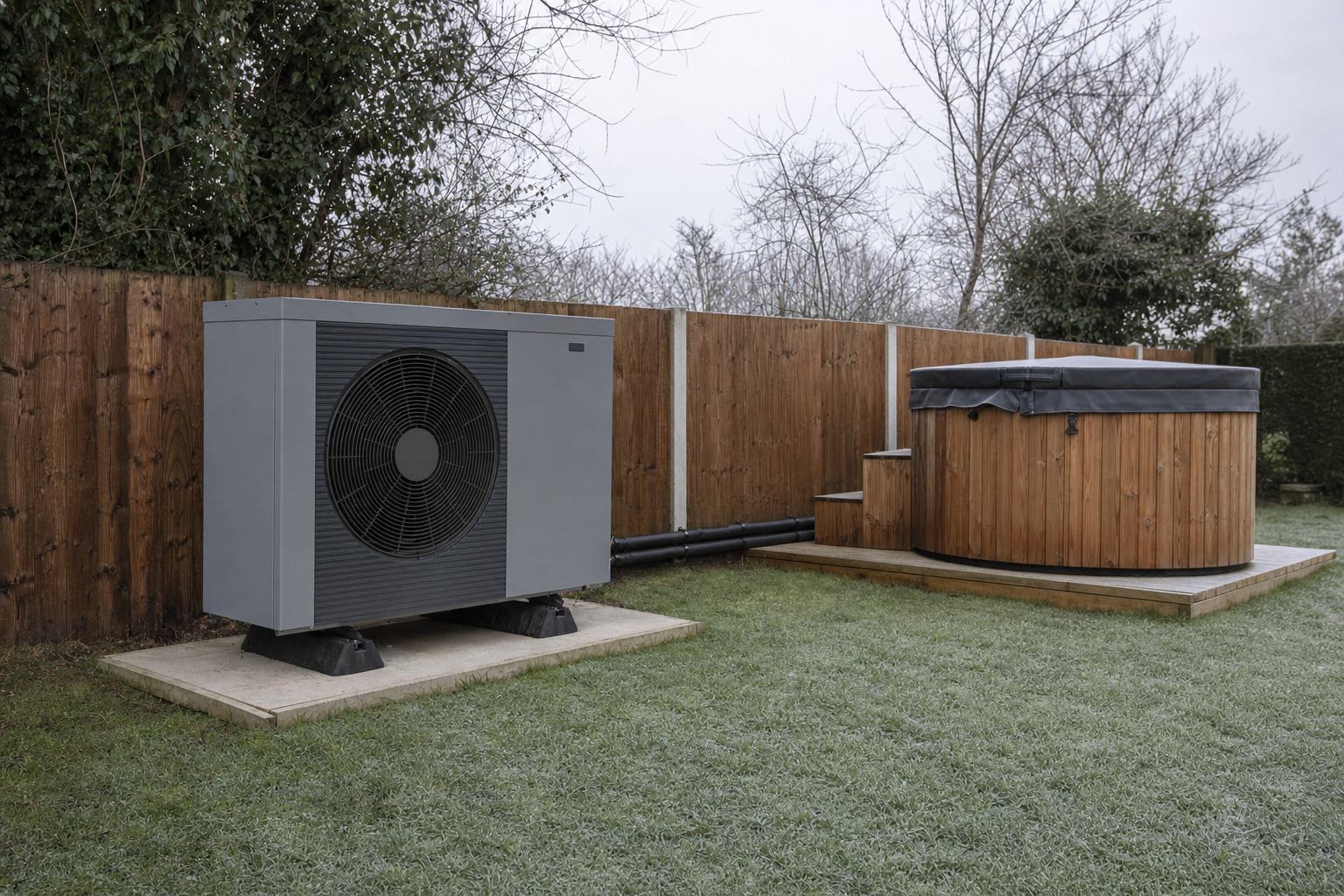
General principles, always checked against the manufacturer’s manual and local regulations:
- Open air. Put the unit outdoors with good air movement around it. Don’t sit it in a pit, an enclosed plant room, under decking or in a basement unless the manufacturer specifically allows it.
- Keep clear of openings and low points. Manufacturers set minimum distances from doors, windows, air vents, drains and sources of ignition. With an in-ground tub, be careful about sinking the heat pump into a recess next to it.
- Solid, level base. A concrete pad or paving slab on anti-vibration feet, with room for airflow to the coil and access for servicing.
- Plan the pipe run. Keep the water pipes between the heat pump and the tub as short as practical and insulate them. Leave room for the bypass and valves on your plumbing layout.
If you’re sketching your layout now, you can try your tub, equipment area and pipe runs free in Tub & Pool Designer Pro before you commit to digging.
Electrics and installation: get the professionals in
The refrigerant doesn’t change the electrical side, but it’s worth repeating. A hot tub heat pump needs its own suitably rated supply with RCD protection, the right isolation and correct bonding. That work must be designed and installed by a qualified electrician, and local regulations apply (in the UK, BS 7671, plus Part P in England and Wales; in the US, the NEC and your local code). Never open the sealed refrigerant circuit yourself. Re-gassing or repairing it, especially on an R290 unit, is a job for a trained refrigeration engineer.

Fitting the heat pump into your hot tub plumbing
Whichever refrigerant you choose, the plumbing is the same. The heat pump normally sits on its own loop or on the filtration circuit after the filter, with a bypass and valves so you can control the flow and isolate it for servicing. Size the pump and pipework to the heat pump’s required flow rate, not just the tub. That’s one of the areas where DIY builds most often go wrong.
All of our Hot Tub Plans include the plumbing layout and shopping list for your size, so you can see where the heat pump connects. If your build is more unusual (a heat pump shared with a plunge pool, a long run to the equipment area or a tub with several pumps), our Tub & Pool Designer Pro Plumbing Design service draws the plumbing for your exact project.
FAQ
Is R32 being banned?
In the EU and Northern Ireland, new self-contained heat pumps up to 12kW using R32 can’t be placed on the market from 1 January 2027. Great Britain hasn’t adopted that ban as of November 2026, and in the US R32 is one of the approved lower-GWP replacements for R410A.
Can I keep using my R32 hot tub heat pump?
Yes. The rules cover new products being sold. An existing unit can keep running and be serviced and re-gassed by a qualified engineer.
Is an R290 heat pump safe next to a hot tub?
Yes, when it’s a properly certified unit installed to the manufacturer’s instructions. The refrigerant is sealed inside the unit. Site it in open air, away from pits, drains, openings and ignition sources, and use an engineer trained in hydrocarbon refrigerants for any work on the sealed circuit.
Is R290 more efficient than R32?
R290 has good properties, especially in cold weather and at higher water temperatures, but for holding a hot tub at 37–40°C both gases do the job well. Compare real units on their COP at 15°C air and their low-temperature rating rather than choosing on the gas alone.
Planning the heating and plumbing for your hot tub?
Our Hot Tub Plans come in 21 sizes with dimensions, plumbing layouts and shopping lists, so you know where the heat pump, filter and pumps go before you buy anything. Trusted by more than 1,500 customers.